Author Archives: John Keller

Unknown's avatar

About John Keller

I am a retired Lutheran pastor whose intention is to consent to God's gracious presence and actions within.

What If They Voted?

The Exodus is the identifying story of the Old Testament. The Israelites had been living in Egypt for more than 400 years but their once privilege status had collapsed into brutal slavery. They cried out to God for rescue and God responded. God called Moses to confront Pharaoh and to lead the people back to their promised land in Palestine. God directed ten plagues to beat Pharaoh down and finally, after the death of his own son, Pharaoh released the Israelites from his service.

Pharaoh, however, quickly changed his mind. He and his army pursued the escapees. The Israelites were camped by the Red Sea when they spot Pharaoh’s mighty chariots approaching. Great fear consumed the Israelites as they cried out to Moses,

Was it because there were no grave in Egypt that you have taken us away to die in the wilderness? What have you done to us, bringing us out of Egypt? Is this not the very thing we told you in Egypt, “Let us alone and let us serve the Egyptians” (Exodus 14:12).

I am guessing that if a vote was taken that day, the overwhelming majority of Israelites would have voted to return to Egypt. Their fear overruled their faith. The story of the Exodus would have been blown away on the desert winds. Has such fear attacked your heart?

No vote was taken. Instead Moses, God’s chosen leader, declared,

Do not be afraid, stand firm, and see the deliverance that the Lord will accomplish for you today. The Lord will fight for you, and you have only to keep still” (Exodus 14:13).

Song of Miriam by artist He Qi

Instead of a vote, God gave a promise through Moses. The people listen. God sent a strong east wind that drove back the chaotic sea and turned the water into dry land. The people crossed safely. When Pharaoh’s army tried to cross, “God tossed the Egyptians into the sea” (Exodus 14:27). Miriam sang a victory song.

Today our world may seem overwhelming and chaotic, instilling fear in us. We may fear financial or relational chaos; we may be too frightened to move forward in our life. Yet God’s promise stands today. The Lord will fight for you! God has not abandoned His people, only tested us to see if we will trust Him as God guides us into God’s  future.

How is fear holding you back from accomplishing God’s will?

Lord Jesus, your kingdom come, your will be done.

A Rabbi’s Taste of Manna

One of the joys of writing for Resurrection Lutheran and others is that I learn from other blogs. Recently I discovered a blog from a Jewish rabbi in Pennsylvania who has great perspective on the story of manna in the wilderness.

One of the recurring themes of the Exodus is complaining. The people whine about being thirsty, hungry, tired, scared, or because they want to go back to Egypt. No matter how much Moses reassures them, or how often they see God’s power displayed, they remain discouraged and depressed. This week, we see them rebel against the manna.

The manna, however, is really just the symptom. The Israelites aren’t dealing with the real issue and the underlying problem that permeates every other situation: They don’t want to be there! They would prefer slavery to independence, because it means they don’t have to move, they don’t have to change, and they don’t have to try. How often don’t we see this happening today? People put up with an awful lot if it means they can avoid change.

Only once the Israelites take ownership of the Exodus, and feel a desire to conquer Canaan and become a nation, are they able to enter the Land. As long as we keep avoiding the real problem, we’re really just going around in circles. We have to face our fears and take on challenges head-on, otherwise we’ll keep chewing on the same bland manna for 40 long years.

How is God challenging you to change?  In what ways are you resisting?

Lord God, teach me again to trust in your grace and mercy to lead me into the changes you desire.

Grumbles and Grains

Shortly after I turned 50 a friend sent me an article written by Garrison Keillor. It was titled:

Stop Complaining.

When you hit 50, you have to stop complaining about getting old, the strangeness of it, the fascination, the horror, etc., etc. That was okay in your 30s and 40s, but now that you’re old, it’s time to shut up on the subject. You shouldn’t complain about aging for the simple reason that nobody gives a hoot. If you were to pay people to care, they might care a little bit for an hour or two, but you didn’t and they don’t. So learn to be cheerful about it. When people ask you how you are, tell them, “Absolutely great. Never better.” (from 50 Things to Do When You Turn 50) 

I thought about Garrison’s advice as I read parts of Exodus. The Israelites are set free from Egypt but they immediately start to complain and grumble. First they don’t have sufficient water to drink (Exodus 15:24). Then they don’t have enough food.

The whole company of Israel complained against Moses and Aaron there in the wilderness. The Israelites said, “Why didn’t God let us die in comfort in Egypt where we had lamb stew and all the bread we could eat? You’ve brought us out into this wilderness to starve us to death, the whole company of Israel!” (Exodus 16:2-3).

We humans seem to have this wonderful ability to compare our present situation to some “idealized past” and think we have some right to complain about it. The Israelites practiced selective memory, remembering the sufficient food of Egypt, while forgetting the suffering and hard labor they experience as slaves. So they grumbled to Moses.

Does a grumbling spirit ever take hold in your mind?

The Lord God was quick to answer. The Lord said to Moses, “I am going to rain bread from heaven for you.” (Exodus 16:4). God provided manna for the Israelites throughout their 40 year journey in the wilderness. Manna was a temporary solution until they arrived in the promised land which flowed with milk and honey. It was also a test by which to see if they could give up their complaining and trust in God’s provision.

Have you learned to stop complaining and to trust in God’s blessing?

Lord Jesus, give us this day our daily bread.

Send Someone Else!

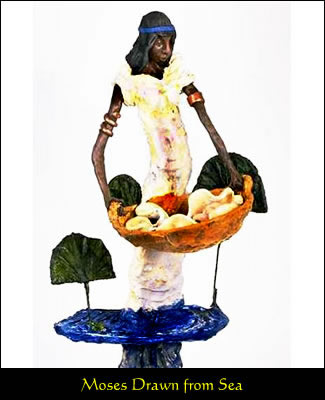
The book of Exodus is rich in stories: Hebrew mid-wives protecting the newborn children, Moses drawn out of the Nile River by Pharaoh’s daughter, the cry of the Hebrew slaves for God’s mercy. The central story is the exodus itself as God battles Pharaoh for the freedom of the Hebrew slaves until Pharaoh’s army drowns in the Red Sea. What a spectacular victory, worthy of song and dance (Exodus 15:20-21).

Art Prints
Yet my favorite story is the call of Moses at the burning bush (Exodus 3). God calls out of the bush to Moses by name. He tells Moses to remove his sandals because he stands on holy ground. God continues, “I am the God of your father, the God of Abraham, the God of Isaac and the God of Jacob. I have heard the cries and know the suffering of my people in Egypt. I will bring them to a good land flowing with milk and honey. I will send you to Pharaoh to bring my people out of Egypt.”

One can hear Moses cheering through the first part of God’s speech. “Yes, Lord, it’s about time you set your people free.” But then Moses’ cheering stops when he hears God’s plan includes him. Immediately Moses interjects, “Who am I that I should go to Pharaoh and bring the Israelites out of Egypt?” Moses then puts forward five different complaints as to why he should not be the one. My favorite comes at the very end, “Oh my Lord, please send someone else” (Exodus 4:13).

I confess that I see myself in Moses’ response. Like Moses, I know that there is mistrust, injustice and need in the world. Like Moses, I know that God needs pioneers who will prepare the way of God and lead God’s people to freedom. Like Moses, I know God is pulling at my heart, mind and soul to be a leader. But like Moses, I too often say, “Lord, send someone else!

The good news in this story is that Moses, after complaining long and hard, went to Egypt and confronted Pharaoh. Moses caught fire and blazed with God’s Spirit. God is trustworthy to give us each the strength and courage to do his will.

To what adventures is God calling you?

Lord Jesus, give me ears to hear and feet to follow.

The Good Becomes Bitter

Exodus has an odd beginning. At the end of Genesis, Joseph had brought his large family to reside in Egypt to avoid the famine in Palestine. Joseph died as did his brothers, yet their clan remained in Egypt, fulfilling Genesis 1:28 by being fruitful and multiply.

But the Israelites were fruitful and prolific; they multiplied and grew exceedingly strong so that the land was filled with them. Exodus 1:7

This sounds like good new; the clan was becoming a nation. However Egypt was not the land God had promised for Israel. Though it had large food reserves and tremendous opportunities, this was NOT where God want the Israelites to be. At the very end of Genesis, Joseph reminded the people that someday they would return to Palestine.

There was a gap of some 430 years during which the Bible is silent regarding God’s interaction with the Israelites in Egypt. Only after this silent gap do we read how God moved the people from Egypt to the Promised Land. I wonder if God was speaking during this time, but the Israelites were not listening.

Whatever the case, the story of Exodus begins with a Pharaoh who did not know Joseph. The Pharaoh decided to oppress and restrict the Israelites. The Pharaoh declared forced labor, “The Egyptians became ruthless in imposing tasks on the Israelites and made their lives bitter with hard service.” Exodus 1:13-14.

What had started as a place of refuge and safety became a land of oppression and slavery. I wonder if that might not be true for many who live in our modern suburban landscape. So many of us move here as a place of safety and prosperity, but then we become trapped by our expectations and appetites. We need to work longer hours to meet the mortgage and other financial obligations we seek. We enroll our children in sports or the arts, but then become slaves to their schedules and expectations. Marriages crumble under the strain and alcohol becomes the master of our lives. Or we simply wake up one morning wondering why we feel empty and alone. The “good life” has slipped away in the night.

Fortunately the Exodus story does not remain in bondage. Freedom is coming.  God will lift Moses up.

How have you experienced bondage or slavery in your life?

Lord Jesus, awaken my spirit to hear your call to freedom.

The Call of the Cottonball

Vocation and God’s calling has always been an interest of mine. I blogged about a few times.  How do we discern what God is calling us to do with our lives?  How do young adults discern their career path?   Too often the church has restricted God’s callings to specific Christian ministries like pastors or missionaries.  But God calls us to love our neighbor in such a wide variety of ways.  Here is a post from a college student who is beginning to grasp her calling as a teacher:  Catapulting Cotton Balls.

When I read this blog, I had a strong sense of pride, hope and humility.   I had the strong sense of pride because my daughter is connecting her vocational calling to her Christian faith.  I had a sense of hope because she and many, many other young adults see their vocation as a way of serving the world and not simply a way to make money.  And humility that she is learned this in spite of my sporadic, often absent, parenting skills.   God is truly good.

How have you experienced God’s calling in your life?  In your family life?

Lord Jesus, remind me again today that I am called to love my neighbor.  Call me once again to be your hands, feet, voice and heart in the world.

Joseph and the Dreamcoat

Joseph and his brothers by French artist Leslie Xuereb

As Resurrection Lutheran strides through God’s Great Story in Sunday worship, this week we stop to observe Joseph the dreamer. Joseph’s story covers the final third of Genesis, chapters 37 to 50. A character study, we watch Joseph mature and embrace his unique calling from God.  Like many, his story will be a bumpy one.

At first Joseph strikes the reader as an arrogant, self-absorbed, spoiled teenager of 17. He brags to them of his special dreams in which his brothers and even his father bow down to him (Genesis 37:6). Joseph has not learned to acknowledge God as the source of his gift. He has not learned to be humble in his use of it.  His dream will come true when he rises up to become second-in-command in Egypt. However, before Joseph can rise up, he will be beaten down several times.

His jealous brothers will attack him and sell him into slavery in Egypt. He will rise up as a favored administrator in a local household, only to be tossed in jail when he is unjustly accused of adultery. He will languish in prison because others have forgotten his talent with dreams. Joseph is on an emotional rollercoaster. Through all the dips and turns one refrain remains constant: “The Lord was with Joseph.” (Genesis 39:2, 23) God did not prevent Joseph from suffering unfairly, but gave him the strength and courage to walk through it.

When Joseph finally has his chance to help the Pharaoh with his dreams, Joseph gives God full credit.

And Pharaoh said to Joseph, “I have had a dream, and there is no one who can interpret it. I have heard it said of you that when you hear a dream you can interpret it.” Joseph answered Pharaoh, “It is not I; God will give Pharaoh a favorable answer.” Genesis 41:15-16

Humility can be a difficult lesson to learn. For years, Joseph sat in jail due to a false accusation.  Early in my ministry I faced an unfair accusation from a visitor to my church.  I wanted to yell and shout, but all I could do was keep silent and let the accusation fade away with time and the help of others.  Until it did I was constantly praying, “why Lord, why?”  No direct answer came, only the promise of God’s presence.  Like Joseph, I had to learn the valuable lesson that God was in charge.

When have you learned a difficult lesson through a humbling experience?

Lord Jesus, humble me that I might trust you completely.

No Place Like Home

My siblings are preparing to sell Mom’s home. My mom has lived in a memory care unit in Woodbury for nearly a year. She lived in her home in Bremerton WA for more than 40 years, but I doubt she will ever return. I lived there for only six years before leaving for college and then seminary, yet I have a deep attachment to the place. A big part of the attachment was the magnificent view from the back deck, so my brother sent me a last picture from that favorite spot.

The steel-blue waters of the Puget Sound were a steady source of comfort and peace. The ferry from Seattle emerged from Bainbridge Island every few hours as well as the occasional sailboat. Once a huge the huge aircraft carrier, USS Enterprise, steamed by, heading for the naval shipyard. In my first couple of summers there I had a small row-boat in which I explored neighboring bays. It was crushed in a winter storm. Ships and boats on the Sound would come and go, but the constant slap of the waves never left me.

I always struggle with the final vision of Revelation 21:

Then I saw a new heaven and new earth; for the first heaven and the first earth had passed away, and the sea was no more. Rev. 21:1

I understand that for the Jews the sea was a symbol of chaos and destruction. Just read the story of Noah or Jonah in the Old Testament. The Jews were not sailing people, so the promise of no sea was good news for them. I however would miss it.

Bremerton Ferry and Mount Rainier

I am guessing that mom’s house will sell quickly, especially if someone stops by on a very clear day (okay, Washington state does not have a surplus of those). But what you cannot see in my brother’s  picture is Mount Rainier on the horizon. On a bright clear day it stands like a giant snow ball for all to see. It was a constant reminder of me that God loomed over all, even when the clouds block my sight. I hope the new owner discovers the same inspiration I have experienced.

Is there a place that inspires and comforts you?

Lord Jesus, thank you for your promise to be always with us, no matter where we are.

Seeking Sarah’s Tomb

The Narrative Lectionary that Resurrection Lutheran Church is using this year skips through the Old Testament at a fast pace. This coming Sunday we will be studying Joseph and his Amazing Technicolor Dreamcoat. But before I shift our focus to Joseph and Egypt, I want to examine one final story of Abraham. In Genesis 23, Abraham’s beloved wife Sarah dies and he must find her a tomb.

When God first called Abraham, God promised him land and descendants. When Abraham arrived in Canaan, the Lord said to him, “To your offspring I will give this land” (Genesis 12:7). His descendants will be as many as the stars of sky.  Yet as Abraham nears death, he has only one son and no land. Is God’s promise ever to be reality? Have you, like Abraham, ever wondered if God’s promises would become reality for you?

After Sarah’s death, Abraham goes to the Hittites who own the surrounding land and says, “I am a stranger and an alien residing among you; give me property among you for a burying-place, so that I may bury my dead.” (Genesis 23:4). The Hittites recognize Abraham as a great man and are willing to give him a burial site for his wife. But Abraham does not want a “gift” or “honorary guest” burial site; he wants to own the burial site with proper title. He wants something permanent and legal that can be passed on to future generation.

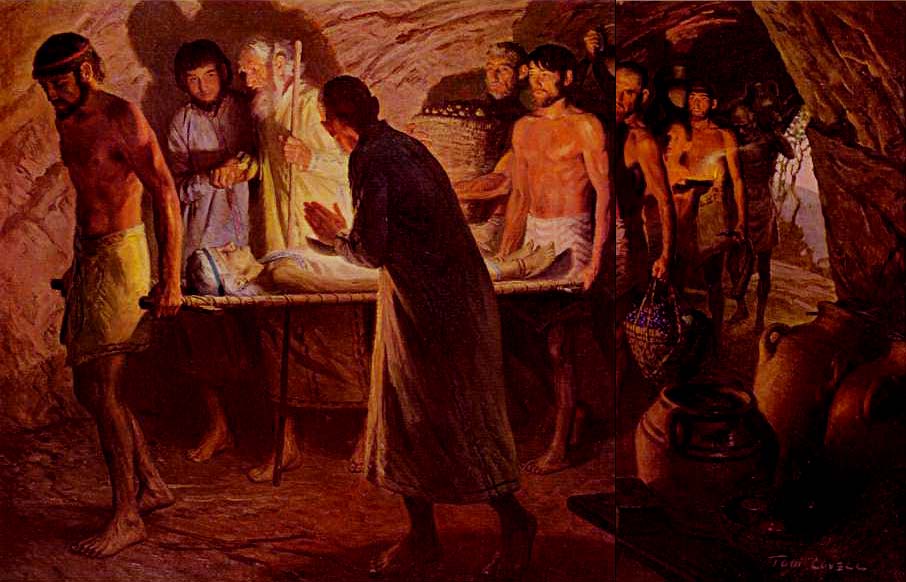
Abraham is willing to pay top dollar for it. (A stewardship sermon is buried in that verse!)  After skillful negotiation, he purchases the small field of Ephron in Machpelah where he buries his wife in a cave in the field (Genesis 23:15-19). Years later Abraham is buried there as well.

At first, a burial plot may seem like a useless, pathetic fulfillment of God’s great promise to Abraham and Sarah. Is this all the land God can give?  Yet it is the first step in God’s patient, enduring plan of salvation. It becomes a sign of hope and possibility.

After all, as Christians, we remember that God’s plan of restoration culminated in the empty burial tomb of Jesus on Easter Sunday. Jesus’ empty tomb is the first step, the first fruits, of a new heaven and a new earth.

 Christ has been raised from the dead, the first fruits of those who have died (I Corinthians 15:20).

In what ways does God give you hope in difficult times?

Lord Jesus, you are my rock and shield, give me the hope I need this day.

Commanding Sacrifice

The Old Testament disturbs many readers with its many violent and destructive stories, at times commanded by God. One story in Abraham’s life has challenged many readers. God commands Abraham to take his son, his only son Isaac, to a mountain and to offer him as a burnt offering to God (Genesis 22:2). Abraham faithfully follows the instructions and takes Isaac, a knife and wood for the offering. In a very poignant scene, as Abraham and Isaac climb the mountain, Isaac carrying the wood, he calls out,

“Father!” And he said, “Here I am, my son.” He said, “The fire and the wood are here, but where is the lamb for a burnt offering?” Abraham said, “God himself will provide the lamb for a burnt offering, my son.” So the two of them walked on together. (Genesis 22:7-9)

I wonder what Abraham was thinking as they walked together. Isaac was his only son, the long-awaited promise from God. Clearly Abraham loved and cherished his son. Yet he faithfully followed God’s command. Perhaps he had half-expected it since many of the surrounding gods in ancient Palestine required such a sacrifice of the first-born child. Still I think Abraham’s steps were as heavy as his heart as together they walked up the hill. And then, when he actually bound Isaac, laid him on the wood, and raised the knife to kill him, I simply go numb.

Before we become too critical of the violence in this ancient story, let us not forget the violence in our own culture. In the last century, humanity has turned death into an industrial machine, killing people by the millions. Last week a family home in Oakdale erupted in murder and suicide. Violence is not simply an ancient problem.

And we read this story, knowing it is a test from God (Genesis 22:1). God had to see if Abraham would be faithful in trusting God. As Abraham raised the knife, God again spoke,

“Abraham, Abraham!” And he said, “Here I am.” 12 He said, “Do not lay your hand on the boy or do anything to him; for now I know that you fear God, since you have not withheld your son, your only son, from me.”  And Abraham looked up and saw a ram, caught in a thicket by its horns. Abraham went and took the ram and offered it up as a burnt offering instead of his son. (Genesis 22:12-13)

Trusting God can be very difficult at times. Yet God proves to be faithful to Abraham, Isaac and to all humanity.

One last thought: Christians often think the mountain where Abraham “sacrificed” Isaac was the same mountain where 1600 years later Jesus, God’s son, died for us.

Lord Jesus, thank you for absorbing our human violence and sin on the cross.