Category Archives: crucifixion

Hope Runs Eternal

The biggest problem with Minnesota winters is not the severity: not the deep cold, not the large snow falls, not the short dark nights. The real problem is the duration. Winter drags into March and even parts of April. There may be teasers of warm weather, but winter usually has a second or third slam to deliver.

What a difference this year. Not just one day of beautiful warm spring weather, but a whole week. I was able to run the trails at Afton State Park today and though muddy, it was a delight. What a joy to be alive. The exercise, prayer and sunshine gave me a feeling of hope. After all, hope runs eternal.

As a Christian, hope is a critical part of my belief system. I recognize that life is often cruel, unfair and extremely difficult. I remember that every time I do a funeral or visit a hospital room. I also remember it when I make the yearly journey with Jesus to Calvary and the cross. Here is someone who was willing to suffer and die, in the hope of the resurrection. Jesus died for me and he rose for me. I cannot prove the resurrection, but I see plenty of evidence in the New Testament and in the lives of God’s people. I am hopeful that though the wrong seems oft so strong, God is the ruler yet. “While we wait for the blessed hope and the manifestation of the glory of our great God and Savior, Jesus Christ” Titus 2:13 (NRSV)

 My own hopeful news is that after nearly a year layoff, my running is back strong. Thanks for the many words of encouragement and prayers. As I was running Afton, I thought about its 25K trail race this July. Anyone want to join me? God is good!

Lord Jesus, let me run or walk or sit or be with you daily.

Adam versus Jesus

If death got the upper hand through one man’s wrongdoing, can you imagine the breathtaking recovery life makes, sovereign life, in those who grasp with both hands this wildly extravagant life-gift, this grand setting-everything-right, that the one man Jesus Christ provides?  (Romans 5:17.The Message)

The story of Adam and Eve is central to the Christian’s understanding of the world and humanity’s place in it. In Genesis chapter two and three, God creates man (Hebrew: Adam) from the dust of the earth (Hebrew: Adama). He places Adam and later Eve, in a garden called Eden to till and keep it. They are given great freedom, with one rule to remind them of their dependence on God, their creator: do not eat from the tree of the knowledge of good and evil.

All goes well until the serpent talks Eve into the fatal bite. Adam joins her in the rebellion against God. When God comes to visit, they hide, ashamed of their nakedness. God give them the opportunity to confess but in turn they blame another. Adam blames Eve. Eve blames the serpent. God casts them out of the garden as the consequence of their rebellion.

The story is way for humans to talk about our in-born tendency to rebel against God. We want to run things our way, to be in charge of our destiny. We all trespass against God’s rule. As Paul write in Romans 5, one man’s trespass shows us the reality of sin and death in each of us.

But humanity’s rebellion is not the end of the story, but rather the beginning. God immediately begins a rescue mission. In Genesis 3:21 God provides garments for Adam and Eve from the skins of animals. Death provides protection to humans, a foreshadowing of the cross.

The rescue is completed in the death and resurrection of Jesus Christ. If death can come through one man, then surely new life can come through one man, Jesus Christ, the son of God. Jesus is so much greater than Adam or you or I. Jesus Christ lavishly dispenses the free gift of God’s mercy and grace. New Vibrant Life flows forth from the cross of Christ. We are sinners, but we are REDEEMED and FORGIVEN sinners. We are sons and daughters of muddy earth, yet we are also Princes and Princesses of God’s Kingdom. Let’s rejoice in that reality.

Lord Jesus, let me live as your forgiven child, trusting always in your grace.

The Mask of Mardi Gras

Today is Mardi Gras, the day of celebration prior to Ash Wednesday.  Tomorrow we begin Lent. As a pastor I am more mindful of Ash Wednesday, but I understand the attraction of Mardi Gras. Most of us like a good party, a reason to celebrate. Since Lent is a time of spiritual discipline, which can involve fasting or personal denial, at Mardi Gras one can “excuse” oneself from the anticipated denial by celebrating in wine and song.

One piece of Mardi Gras captured my attention this year, the use of masks. My guess is that you still do not want to be recognized during the celebration. You fear that you might do something so embarrassing that you prefer to be anonymous. But most masks are very superficial and do not truly cover your identity. It may be more of a psychological mask that allows you to behave in a way you wouldn’t otherwise.

Masks are something that come off on Ash Wednesday. The central theme of Ash Wednesday is our mortality. Adam was told after his rebellion against God, “From dust you come and to dust you shall return” (Genesis 3:19).  The imposition of ashes marks us as mortal sinners.  We may party hard today, but eventually the party ends. The grave will “unmasks” us all.

The season of Lent marches towards the cross of Jesus, where the Son of God is executed. The human rebellion against God is fully revealed. No masked will be allowed on that day.

But then God turns everything around with Easter Sunday. It is no longer masks we wear, but a new resurrected body. The shining reality of God’s mercy and love shines in every hue and color. That celebration is even bigger than Mardi Gras.

Lord Jesus, show me how to find my joy in you.

Authority to Forgive

Though most of us spent decades in classrooms, rarely do we remember a specific class. Each hour of instruction tends to blend with the others to build a cumulative base of knowledge. Occasionally one hour of instruction will stand out among all the others. One such hour for me was my first year at Luther Seminary in 1977. The class was being taught by Dr. Warren Quanbeck, a renown Lutheran theologian.

One monring he was leading us through a story in the Gospel of Mark, the healing of the paralytic (Mark 2:1-13). He pointed out the controversy surrounding Jesus’ announcement that the man’s sins were forgiven. The religious scribes thought it was blasphemy for Jesus to claim such authority. Then Dr. Quanbeck asked a question that rocked my understanding of Jesus and forgiveness.

“If Jesus died in order to forgive us our sin, how could he forgive the sins of the man prior to his crucifixion?”

Like many Christians, I had grown up with a rather simplistic idea that Jesus “paid” the penalty for my sins by being a sacrifice to the righteousness of God. Often this line of reasoning turns God into a “mean vindictive judge” who demands the death of his only son. Dr.Quanbeck challenged that understanding by pointing out that Jesus was forgiving sin prior to his death just as God had been doing in the Old Testament. God’s business is forgiveness.

What put Jesus on the cross was the human inability to accept such gracious mercy and love. Throughout the Gospel of Mark we witness this tension with the religious official over Jesus’ authority. Ultimately they crucify Jesus precisely because he claimed the divine power to forgive sins. It was humanity’s ultimate rejection of God’s grace. But God would not be denied. To demonstrate Jesus’ authority, God raised him from the dead and turn the crucifixion into the very path to eternal life.

Dr. Quanbeck died less than two years after that class. But his instruction guided me into a deeper understanding of God’s grace and mercy. Thanks be to God.

Do you remember a class, teacher, or moment that rocked your understanding of God?

Lord Jesus, thank you for being so gracious towards me.

Words of Death and Life

The Old Testament prophets were poets and strong words were their tools. The prophet Hosea used offensive language to stir up the people and to call them back to God. The graphic words were to be a shock to the community in hope that they would repent.

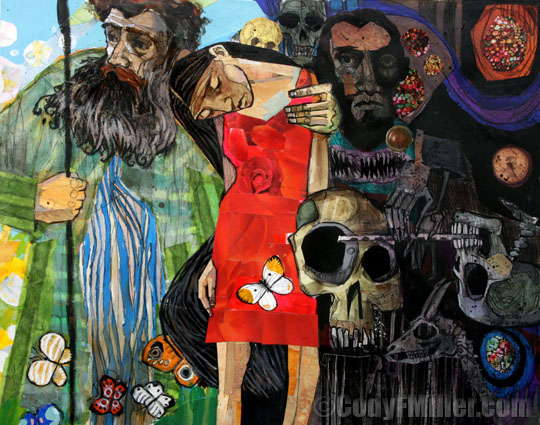
Hosea and Gomer by Artist Cody F. Miller

In the first chapter, Hosea was directed by God to marry an unconventional wife.

The Lord said to Hosea, “Go, take for yourself a wife of whoredom and have children of whoredom, for the land commits great whoredom by forsaking the Lord.” (Hosea 1:2)

His chosen wife, Gomer, may have been a temple prostitute from one of the fertility cults or a simple street prostitute of the city. She bore children to Hosea to whom Hosea gave symbolic names, No-Pity and Not-My-Children, demonstrating God’s strong disfavor with the fickle people of Israel. Afterwards Hosea spoke an extremely harsh word to the people.

Plead with your mother, plead— for she is not my wife, and I am not her husband— that she put away her whoring from her face, and her adultery from between her breasts, or I will strip her naked and expose her as in the day she was born, and make her like a wilderness, and turn her into a parched land, and kill her with thirst. Upon her children also I will have no pity, because they are children of whoredom.

God was angry with Israel’s infatuation with other religions. Instead of being a shining beacon of the Lord God for other nations, they had embraced the gods of other nations, forsaking their unique covenant with God. They had become like a spouse caught in adultery.

The harsh violent language of Hosea can be a shock to our spiritual sensibilities. How can God speak in such cruel severe words?

Perhaps the words are so harsh, because the people’s hearts were so hard. Or perhaps they are so cruel because our hearts are so hard. The words of the prophet “killed” the people (including us the reader), so that God can create a new heart, a new life: a kind of resurrection.

Therefore I will now allure her and speak tenderly to her, . . . I will take you for my wife forever; I will take you for my wife in righteousness and in justice, in steadfast love and in mercy. (Hosea 2:14,19)

Finally the Lord declared, “I will have pity on No-Pity, and I will say to Not-My-Children, ‘You are my people’” (Hosea 2:23). I cling to these words of hope and restoration.

Lord Jesus, the Word of God, you absorbed our sin in your death on the cross. Speak to us again the Word of Life.

Commanding Sacrifice

The Old Testament disturbs many readers with its many violent and destructive stories, at times commanded by God. One story in Abraham’s life has challenged many readers. God commands Abraham to take his son, his only son Isaac, to a mountain and to offer him as a burnt offering to God (Genesis 22:2). Abraham faithfully follows the instructions and takes Isaac, a knife and wood for the offering. In a very poignant scene, as Abraham and Isaac climb the mountain, Isaac carrying the wood, he calls out,

“Father!” And he said, “Here I am, my son.” He said, “The fire and the wood are here, but where is the lamb for a burnt offering?” Abraham said, “God himself will provide the lamb for a burnt offering, my son.” So the two of them walked on together. (Genesis 22:7-9)

I wonder what Abraham was thinking as they walked together. Isaac was his only son, the long-awaited promise from God. Clearly Abraham loved and cherished his son. Yet he faithfully followed God’s command. Perhaps he had half-expected it since many of the surrounding gods in ancient Palestine required such a sacrifice of the first-born child. Still I think Abraham’s steps were as heavy as his heart as together they walked up the hill. And then, when he actually bound Isaac, laid him on the wood, and raised the knife to kill him, I simply go numb.

Before we become too critical of the violence in this ancient story, let us not forget the violence in our own culture. In the last century, humanity has turned death into an industrial machine, killing people by the millions. Last week a family home in Oakdale erupted in murder and suicide. Violence is not simply an ancient problem.

And we read this story, knowing it is a test from God (Genesis 22:1). God had to see if Abraham would be faithful in trusting God. As Abraham raised the knife, God again spoke,

“Abraham, Abraham!” And he said, “Here I am.” 12 He said, “Do not lay your hand on the boy or do anything to him; for now I know that you fear God, since you have not withheld your son, your only son, from me.”  And Abraham looked up and saw a ram, caught in a thicket by its horns. Abraham went and took the ram and offered it up as a burnt offering instead of his son. (Genesis 22:12-13)

Trusting God can be very difficult at times. Yet God proves to be faithful to Abraham, Isaac and to all humanity.

One last thought: Christians often think the mountain where Abraham “sacrificed” Isaac was the same mountain where 1600 years later Jesus, God’s son, died for us.

Lord Jesus, thank you for absorbing our human violence and sin on the cross.


Two Portraits of Jesus

In John 17, Jesus prayed with confidence and clarity.  After finishing the Last Supper  Jesus looked to heaven and prayed, 

Jesus looked to heaven

So now, Father, glorify me in your own presence with the glory that I had in your presence before the world existed. (John 17:5)

This confidence is such a strong contrast with the prayer he prayed in Matthew, Mark and Luke when he went to the Garden of Gethsemane a short time later.  As the disciples slept, Jesus prayed for strength to face the cross:

Jesus praying in Gethsemane by artist He Qi

Abba, Father, for you all things are possible; remove this cup from me; yet, not what I want, but what you want.  (Mark 14:36)

In John’s Gospel there is no prayer in the Garden.  In Matthew, Mark and Luke there is no extended prayer at the Passover meal.

Such contrasts can be disturbing for some.  I believe that the Gospels of Matthew, Mark, Luke and John are more like portrait paintings than historical biographies.  Whereas John’s Gospel  paints a portrait in which Jesus had a laser-like focus on his “hour” to be glorified on the cross (John 2:4, 7:30, 8:20, 12:23, 12:27, 13:1, 17:1), Mark’s Gospel shows Jesus wrestling with this cosmic decision as he approached the cross (Mark 14:32-41).  Both portraits are true, yet they reveal different insights.

Mark reveals that Jesus was truly human; his emotions were raw and deep.  On the cross he would cry out, “My God, my God, why have you forsaken me?”  (Mark 15:34).  Jesus understood our own human dilemma, our trials, our brokenness.  Mark’s portrait is so brutally human.

John reveals the divine purpose of Jesus and his constant trust in God’s purpose.  Jesus accomplished God’s purpose of reconciling the world.  As he breathed his last breath, Jesus said, “It is finished, (accomplished, completed).” John’s portrait is so beautifully divine.

In my own life, at times I find support and comfort in Mark’s raw intimacy.  At other times, I am inspired and uplifted by John’s cosmic vision.   Together with Matthew and Luke, I have a deeper understanding of the mystery of Jesus Christ, my Lord and my God.

What stories of Jesus do you turn to most often?  What stories do you try to ignore?

Lord Jesus, be my light in the midst of whatever confusion or darkness I experience this day. 

The Holy Week Story – Friday

Crucifixion by Mexican Artist Octavio Ocampo

Holy Week Reflections for Friday

Read Matthew 27:32-56

Those who passed by derided Jesus, shaking their heads, and saying, “You who would destroy the temple and build it in three days, save yourself! If you are the son of God, come down from the cross.”  Matthew 27:39-40


Crucifixion was always done in public spaces so that Rome could demonstrate its power.  Thus Jesus was crucified out in the open, naked and humiliated, for all the world to see.  This was no private affair, like John the Baptist’s beheading inside King Herod’s palace.  Anyone and everyone mocked Jesus: the religious elite from the temple, those who passed by, even those hanging on the cross next to Jesus. (In Luke’s gospel, one thief repents, Luke 23:42-43.)  The public humiliation added to the pain and suffering. 

An amazing aspect of the taunts was that they held truth.   Jesus could have saved himself and stepped down off the cross, but instead chose to save us and stayed nailed to the cross.  The sign above his head mocked him as ‘King of the Jews;” yet the cross becomes Jesus’ throne of mercy, his royal decree of forgiveness and hope. He was “the temple of God,” where God’s Spirit resided.  

When I was in confirmation, I remember taking a test that asked for the name of the day on which Jesus died.   The answer had two blanks.  I knew that the second blank was Friday, but I could not remember what word filled the first blank.  I racked by brain, “blank Friday, blank Friday.”  Finally I filled in the blank with the word: Bad, Bad Friday.   My thinking was that it was certainly a bad day for Jesus with his suffering and death.

Of course I was wrong.  We know the day as Good Friday, because it was good for us.  God turned humanity’s total rejection of his love into the final victory for us. 

How does Jesus’ death tell the truth about our lives and world?  How does it give us hope? Where do you see God at work to redeem creation?

Prayer: Lord God, on the cross you suffered the very depths of our human brokenness and sin. Your humiliation on the cross became our path to You.  Help us to remember the depth of your love and the powerful hope you give.