Category Archives: Uncategorized

Intersecting Hell


Where do you dwell?

My recent readings have intersected.  I have been reading a series of lectures on C. S. Lewis by a Dr. Louis Markos as well as reading Rob Bell’s Love Wins: A Book about Heaven, Hell, and the Fate of Every Person Who Ever Lived.   Bell starts with Jesus’s word for hell, Gehenna.  Gehenna was an actual valley outside of Jerusalem that was used as the city dump, where fires burned constantly and animals gnashed teeth as they fought for scrapes.   Gehenna was not desirable real estate. 

Lewis wrote about hell in The Great Divorce.   His image of hell: dirty, grey mean streets of a city slum where it is always dusk and always raining.  Scholars think Lewis was using London during a smog alert.  (I might be tempted to use a picture of Minnesota in March, when snirt (snow/dirt) never leaves and spring never comes. )   Lewis’ basic definition of hell is the absence of God: where God says to those who reject Him, “your will be done.” 

 Both Bell and Lewis agree that hell is not only a destination to be avoided after death.  It can be our reality right now.  Hell emerges when we allow our sinful nature to dominate our lives.  It can be drugs, alcohol, ambition or greed.  Or it can be something simple like grumbling.   C. S. Lewis wrote,

Hell begins with a grumbling mood, always complaining, always blaming others . . . but you are still distinct from it. You may even criticize it in yourself and wish you could stop it. But there may come a day when you can no longer. Then there will be no you left to criticize the mood or even to enjoy it, but just the grumble itself, going on forever like a machine. It is not a question of God ‘sending us’ to hell. In each of us there is something growing, which will BE Hell unless it is nipped in the bud.

The Good News is that God has come to rescue us from hell.  Jesus’ life, death and resurrection carries all who believe into his kingdom of heaven.  Tomorrow I will post on their intersection in heaven.

Do images of hell help or hinder your faith in God?
Singin’ in the Rain

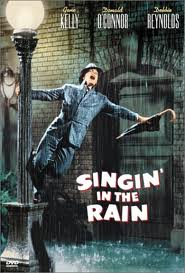
To Sing and Dance with Joy? Put down the umbrella!

Su Sorenson, a member of Resurrection, wrote a devotional that I neglected to place in our congregation’s Lenten devotional.  I truly appreciated her image of taking down our umbrellas.

For I am convinced that neither death nor life, neither angels nor demons, neither the present nor the future, nor any powers, neither height nor depth, nor anything else in all creation, will be able to separate us from the love of God that is in Christ Jesus our Lord.”  Roman 8:38-39

These verses have strengthened me and carried me through tragedies, suffering, and loss.  I have been assured that whatever is happening to me, to those I love, or even to this world, God is still present.  God is still showering me and the world with His love. 

However, there are still times when I am separated from the love of God.  Those times when I build a wall around myself and don’t let God in.  Those times when I put up my umbrella and don’t allow the rain of God’s love and grace to shower me.  I might put up my umbrella when I get busy with my own “to-do list” or begin to feel self-important (how will the place run without me?)  I put up the umbrella when I am exhausted, in times of self-pity, in loneliness.  Yet, God’s love is still there. 

To live in God’s grace I need to step out from the umbrella.  I need to stand in the rain, to be washed each and every day with God’s love and power.  Nothing will be able to separate us from the love of God when we take down our umbrellas.  Will you take your’s down too?  Enjoy the shower.

Dear God, continue to tug at my umbrella so I may be fully washed in your love and grace, each and every day.  Amen

Bet the Farm on Jesus

My blog’s name, Trust Live Serve, comes from Resurrection Lutheran Church where I am  pastor.  As a congregation we are called to Trust in Jesus as Savior, Live the call of God’s Word, and Serve the World God loves.   The first phrase, Trust in Jesus as Savior, gives centrality to Jesus Christ.  Without Jesus’ life, death and resurrection there would be no reason for any church to gather.  As we move towards Holy Week and the mystery of the cross and empty tomb, I am mindful of how Jesus trusted the Father throughout the passion.  Jesus is not only the object of our trust, but a model of what trust looks like.

The Oehlke farm house remains on church property

Yesterday, I met another example of trust.  Inez Oehlke was the former owner of the farm on which Resurrection Lutheran is now built. She had been a faithful member of a neighboring Lutheran congregation, Gethsemane, and she wanted to make a contribution to her congregation.  She also knew that her farm, on the corner of Bailey Road and Woodbury Drive, was prime commercial real estate because, in time, it would be adjacent to a major intersection in this growing suburb.   She had been approached by various commercial vendors who wanted to purchase parts of her farm, but she had a different vision.  She wanted and prayed for a church on the corner.  And her prayers were answered twice.

Resurrection Lutheran from the farm buildings

Not only was Resurrection Lutheran able to purchase this prime location at a very reasonable price, but St. Ambrose Catholic church as well (St. Ambrose is across the street from Resurrection).  Inez used the purchase price to benefit her own congregation and Luther Seminary.  She now lives in a modest apartment here in Woodbury and, at the age of 91, continues to give “talks” or testimonials on the value of being generous.   After my visit with her, I came away blessed by her trust in Jesus.  Inez continues to live a vibrant life of faith.   Trust in Jesus is in the very foundation of this congregation, even in the soil itself.

Who has been a model of trust in Jesus for you?

Tsunami of Grace

How will you respond?

Like so many, I have been overwhelmed by the pictures, video and stories coming out of Japan.   Last week’s earthquake and tsunami were horrific.  Prayers for mercy, compassion and strength are lifted up to God on behalf of the survivors and victims.  Two thoughts rise in my heart and mind.

First, I realize that some people may be asking, “Why God allow this tragedy to happen?  Could He not stop it? Or is it some kind of punishment from God?”  Jesus faced such a question once when asked about eighteen people who were killed when a tower fell on them.  “Do you think that they were worse offenders than all the others living in Jerusalem?  No, I tell you; but unless you repent, you will all perish just as they did.” Luke 13:5.   The people of Japan are no worse sinners than you or I.  We are not entitled to prosperity and safety.  Each day of life is a gift from God that easily be lost.

Part of our repentance, transformation, is to recognized the potential folly of our human enterprise.  I took basic geology in college.  The professor stressed two points for all the non-geology majors: don’t build your home near a geological fault-line nor on a flood plain.  Japan is located near a major fault: earthquakes and tsunamis have and will happen there.   Even with the best technological structures, humanity continues to build where such destruction can/will happen.  We can not blame God for our folly.

But a second thought rises as well.   This is again our opportunity to love our neighbor and to show grace and compassion.   We each can participate in some way in the restoration of Japan and other devastated lands.  I am a citizen of a nation that is already sending support; I can inform my elected representatives that I support such aide.  I am also a member of the Evangelical Lutheran Church in America and I have given financial support to its Disaster Response fund. We are called now to act with the compassion of Jesus so that a tsunami of grace can touch Japan.

There are many agency by which you can help the victims of Japan.  If you want to use the ELCA disaster relief fund or learn more about it, go to https://community.elca.org/NetCommunity/SSLPage.aspx?pid=631

How has the earthquake shaken your life?

“As we forgive others”

Forgiveness

Thursday it was a challenge.   I attended a meeting outside of church.  Prior to going, I had decided that I would practice my Lenten discipline of listening, more than speaking.   I thought that should be easy. Usually I am a good listener.  I was doing well until we broke into small groups and one person began to dominate the conversation.  I would have appreciated the one-way conversation if I had heard clear, wise, helpful  ideas.  But the whole time I listened, I kept thinking, “this is not valuable to me. This person is too self-absorbed to help me.” As I listened,  I began to realize the hardness of my own heart towards another’s life journey.

Since that conversation, I have been wondering if that might not be how God hears many of my prayers, as self-absorbed drivel.  There are times when I pour out the deepest parts of my heart to God, but too often it is the superficial complaints of a spoiled child.  Still God promises to be gracious to me, to listen and uphold me, to seek my presence.  Can I not do that with another?   Can I simply be gracious and attentive to God’s children around me?

The heart of the Lord’s Prayer speaks volumes for my relationship with others.  Forgive me my sins as I forgive those who sin against me.    Yesterday I discovered once again how challenging it is to love my neighbor as God has loved me.  Yet I am forgiven and can start fresh today.

What does forgiving others mean for you?

Integrity of Patience

As I reread Robert Roberts’ The Strength of a Christian, I notice my own impatience rising to the surface.  I want to glean some quick insight into the practice of patience, so that I can immediately apply it to my life.  I want patience NOW.  Roberts provides instruction on the practice of patience (that I will post tomorrow, be patient), but first Roberts makes a wise observation on the necessity of patience for becoming a whole person.

Patience is also a condition for the integration of the person. Like other strengths, patience gives our lives continuity and autonomy, enabling us to live not by impulse, or at the beck and call of environmental stimulus, but by some design.  The Christian design is of course the love of God and neighbor.  It is one thing to have noble sentiments, such as compassion and concern for one’s neighbor and gratitude to God, but quite another to be in the appropriate sense the author of these, the kind of person who through “interior strength” has etched this design upon life.  Only someone self-present in the way a patient person is can practice Christian life as a spirit does. (p. 56)

The strength of an oak tree

When I was in my twenties, I remember reading a Christian article about how God is more interested in growing mighty oak trees than in zucchini.   Zucchini are rather amazing plants in that they grow from seed to fruit rapidly. Yet they will not survive a hard frost.  Oaks take considerable more time.  Yet it is the oak that survives the winter and summer storms and bears witness to God’s glory, year after year, by being the oak it was created to be.    In the same way, as Christian, we are called to serve God faithfully, becoming fully what God created us to be.   Growth in Godly character is often seasonal, with long stretches where one wonders if God has forgotten you. This is where the integrity of patience comes to bear, trusting God is at work, even in the times of waiting and hoping.  I continue to pray and seek patience as God works on my character of becoming a strong oak (see Psalm 1).

Who has been a model of patience for you?

Slow Lent Movement: Part Two

Slow down for Lent

Yesterday I introduced Bishop Payne’s concept of a Slow Lent.   Here are five slow spiritual disciplines that complement traditional Lenten disciplines.

1. Traditional: repentance 
    Slow: speak less, listen more.

In our hurried culture, we often are so quick to speak, to get our words out, that we rarely take the time to listen to what others say, especially those that we disagree with.  We rush to judgment when we need to listen and possibly to change the direction of our thinking, planning, and acting.

2. Traditional: forgiveness
   Slow: let go of one “should.”    

Many of us carry various kinds of “ought’s or should’s” that overload our schedule. We need to “forgive” ourselves.   For example, as a new pastor, I feel I should be involved in different local community activities.  One piece of wisdom I received recently is that a new pastor should not be involved in local community activities during the first year so that he or she can fully enter into the life of the congregation.   So I have given up that “should” even before Lent starts.

3. Traditional: catechesis (teaching)
    Slow: re-learn one basic of the faith

Rather than focusing on the newest spiritual discipline, simply re-focus on some basic spiritual discipline.  This year at Resurrection Lutheran, we will be re-learning the Lord’s Prayer and its meaning for prayer and life.

4. Traditional: fasting
    Slow: choose one way to ‘unplug’

For some Christians, Lent means giving something up so that one can better focus on God.  The usual items are chocolate, desert, alcohol, or meat.   Bishop Payne suggested that perhaps we “unplug” from the internet or turn off our smartphones or television.  We might not be able to do it 24/7, but we might choose to turn it off every evening or every Saturday.  Of course, the purpose is to open our time and our lives in a fresh way to God.

5. Traditional: almsgiving
     Slow: simplify

Certainly we need to be as gracious as our God and give to people in need.   Lent is a great time to practice such giving.  Yet our culture is so focused on the accumulation of things, perhaps we can shift our attention from accumulating to letting go.  My uncle Jerry lived for several years during his retirement in an RV.  Whenever he considered buying something, he had to consider what he would give away to make space for the new.  It made him think twice before buying.

Which discipline might help you slow down this Lent?

Running and Prayer Update

Running with son

A couple of weeks ago I wrote that I have been unable to run pain-free since last spring and that I started a new round of physical therapy at Focus Fitness. (see MAT to PAT http://wp.me/p1e1iu-6A ).  Their staff is helping me to address the muscle imbalances I have developed by a series of exercises that activate weak or inhibited muscles.  Every day I attempt to do these awkward exercises, concentrating to keep the right form and to activate the appropriate muscles.  It is a definite mind-body exercise and I feel very foolish as I do them. 

Of course, last week, I had to try a short run to see if these exercises were having any desirable effect.  I hopped on to a treadmill and started first with a brisk walking pace and then pushed the pace higher to a slow jog.   I quickly discovered that my left IT band and right hamstring continued to complain.   I backed off the pace and stepped off the treadmill, disappointment hanging from my shoulders.   I had hoped for some instant relief.  But instead of running, I am back to the awkward exercises every morning and evening.

I continue to think there is a spiritual lesson for me to learn.  How often do I treat prayer as an instant relief button, hoping that God will magically answer my wish?  How often do I trust the process of praying patiently for God’s will to be done as I keep my focus on Jesus?  How often am I disappointed when things do not turn as quickly as I envisioned?

Also I know that many people feel awkward when they try to begin a spiritual discipline of prayer or scripture reading.   They are unsure whether their prayers are having the desired effect in their life or if they understand what they are reading.  Just like I needed a therapist to help me identify and work the weak muscles, a small group or spiritual mentor can help us begin a new spiritual journey. 

Is your spiritual journey flourishing, struggling or maintaining?  Where do you discover Jesus?

Are You Listening?

To Listen Is To Focus.

When I was about ten years old, I was pulled from my class room and given a hearing test by the school nurse.  I was surprised, since no other student was given the test that day.  I listened carefully to the instructions and dutifully raised my hand whenever I heard the special ping come through the earphones.  I was certain that I had done extremely well, and said so to my mother that afternoon.   Then I told her how strange it was being the only one tested.  

My mom then gave me the second surprise of the day.  She said, “John, I asked for that test, because you don’t seem to listen very well at home.  I was wondering if you had a hearing problem.”  After the test, my mom talked with the school nurse and they agreed that I did not have a hearing problem, but that I did have a listening problem.  I would selectively hear what I wanted to hear, ignoring those sound/voices/instructions that I did not want to hear.  

In a congregation there is always some selective listening.  We tend to pay attention to those activities and ministries that excite or appeal to us.  A busy mother of young children may tune out the invitation to a men’s retreat (or she may tune in if she thinks her husband should go!)  We all have filters that select what to hear, see, or feel.   In our media culture, we are all surrounded by so much “communication noise” in so many forms (music, internet, television, video games, cell phones) that it can be difficult to listen to one another.   Yet each of us can work to improve.

Here are six of my communication rules.  

  1. I never read letters or notes that are not signed. 
  2. Important information deserves face-to-face conversation.
  3. To over communicate is much better than to under communicate.
  4. Never write in an e-mail what you would not say face-to-face.
  5. To over communicate is much better than to under communicate.
  6. God communicates his love to me every day.  Am I listening?

How are your listening for God?  for others?

The Purpose of Scripture

The Bible is Word Power

Have you heard the concept, “The BIBLE stands for Basic Instruction Before Leaving Earth?”   I struggle with that concept.  My fear is that we will turn the Bible into a glorified self-help book that we try to control, rather than the Word of God that comes to recreate us in God’s image.  God’s Word has more than great advice; it has the power to transform us.

N. T. Wright describes this transforming power. “The Bible isn’t there simply to be an accurate reference point for people to look things up and be sure they’ve got them right.  It is there to equip God’s people to carry forward his purposes of new covenant and new creation.  It is there to enable people to work for justice, to sustain their spirituality as they do so, to create and enhance relationships at every level, and to produce that new creation which will have about it something of the beauty of God himself.”   (Simply Christian, p. 182-183)  God’s Word is to actively work at transforming us into the image of Christ.   It calls and empowers us to love God by loving our neighbor in creative, just ways.

Jesus himself had to reinterpret the law because the Pharisees and other religious officials had misused it.   The Pharisee’s loved the Torah (first five books of the Bible), but in their love they tried to control and protect it by building sharp boundaries between holy and unholy.   They tried to avoid all contact with unholy people, so as to remain pure before God.   They used the scripture as their way to stand apart from those in need (lepers, tax collectors, prostitutes, sinners).  Jesus proclaimed a message that engaged the unclean and envisioned a new creation.   Jesus did not come to abolish the law but to fulfill it (Matthew 5:17).

How is God’s Word transforming your life?