Social Media Scream and Seeds

Ahhhhhhh by kennymatic
Ahhhhhhh, a photo by kennymatic on Flickr.

Okay, this social media stuff is becoming more of a challenge. I started this blog over a year ago and I have two Facebook accounts (one for family and one for the congregation) and I use my Droid 3 phone to text my daughter and I have dabbled a bit on Twitter and I want our congregational website to be as current as possible and I need to start an on-line newsletter for the members of Resurrection Lutheran and I know that there are technologies that will link this all together and sometime I just want to SCREAM.

Well, maybe “scream” is a bit of an over-reaction, but certainly I am at time overwhelmed by the technological possibilities that have grabbed hold of our society. I could bury my head in the sand (or an old fashion book), but I feel this call to adapt. After all, the message of Jesus Christ is worth spreading out into the world. I remember that the apostle Paul had to adapt as he made his missionary journeys into the Gentile world. His sermon to the people of Athens revealed how he work to understand their culture, their native religiosity, so as to make a connect to the good news of Jesus Christ (Acts 17:22-34). Every age has had to adapt to new technology and culture. I think one of the great strengths of our Christian faith is that it is adaptable to new times and situations, while staying true to our God.

As I write blog posts and try to compose cleaver tweets, I am reminded of Jesus’ parable of the sower (Mark 4:1-20), my sermon text for this Sunday. The sower was pretty wild in his tossing of seed. He seemed to be intent on flinging it everywhere, with the confidence that it will find good soil. As I post, tweet, facebook, e-mail and preach I need to trust in the power of the Holy Spirit, the wind of God, to carry the seed to productive soil, where the fantastic news that we are loved and cherished by God will be heard.

Lord Jesus, send your word on the wind of your Spirit.

Seeds of Vibrant Life

My posts are often inspired by scripture, but occasionally the Holy Spirit works through other mediums. Drew Jonell is a talented artist and photographer who has won awards as a high school student. He is a member of Resurrection Lutheran Church and his photo struck me as an expression of our congregation’s mission statement: to call all people to a Vibrant Life of Faith in Christ.

There are several ways it expresses the Vibrant Life. First, the brilliant blue sky is the source of light. Jesus Christ is our intense blue sky that creates the vibrations and brilliance in our life with Him. The blue sky draws us into the photograph. Jesus Christ draws us into the Vibrant Life.

Second, the drifting clouds, reminds me of the cloud of witnesses who are mentioned in Hebrew’s 12:1. These clouds of witnesses are all saints of God who have preceded us in faith. They now stand in heaven cheering us on in our faith journey. We are not alone in the Vibrant Life.

Third, the seeds being given to the wind are representative of God’s Word giving us strength and hope for the future. The sower sows the Word (Mark 4:14).

Finally the silhouette reminds me that it is the light of Christ which shapes and forms what people see of me. My life is formed by Jesus; I vibrate to his light waves. Without him, everything would be dark or grey. Yet surrounded by him, I am fully alive.

Thanks, Drew, for being inspired to take this photo.

What gives you inspiration for your Vibrant Life of Faith in Christ.

Lord Jesus, continue to sow the Word of life in me.

New Wineskins

C. S. Lewis wrote an excellent book on literary criticism, An Experiment in Criticism, that is applicable to how one reads scripture. Lewis argues that a critic should not take preconceived opinions into the reading of a book, but remain open to receive what the writer brings. Our culture too quickly labels a book as good or bad and that judgment is often based on some arbitrary taste. Lewis argues that a book would be better judged by what kind of response it elicits from the reader. Does the reader cherish the book and want to read it over and over, reflecting on its meaning, prose and insights?

An open stance towards the reading of scripture is even more important. We need to allow our mind to hear the text. We cannot simply make our own quick evaluation of it nor rely on the comments of a biblical commentary. We need to read Luke as Luke and distinguish it from the perspective of Matthew, Mark and John. We need to keep our own evaluation process out of the reading and allow the text to speak to us, on its own terms. In other words, let the text shape and critique me and not the other way around.

This can be challenging since so much of my reading of scripture has been shaped by what others may have taught or preached. I bring my biases and cultural norms that are hard to place aside so that the text can speak. I struggle to be quiet and receptive to what God may say through the Word. Yet as I open myself, trusting the Holy Spirit to work through the text, I discover the life giving Word.

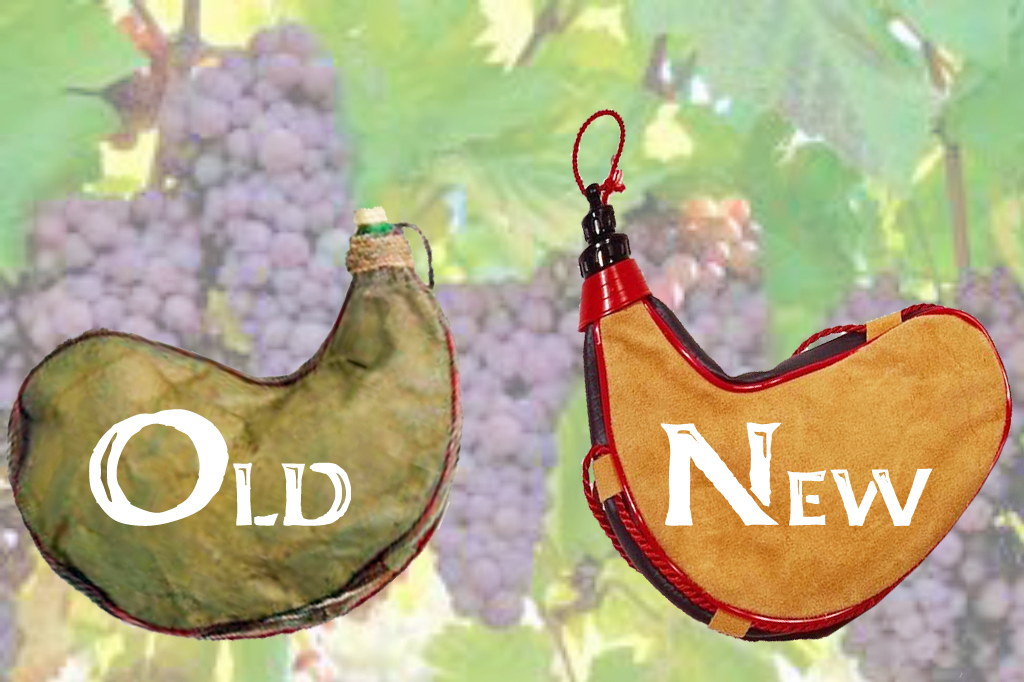
It sort of like Jesus’ teaching that one put new wine into new wineskins, so that as the wine ferments and expands, the wineskin has the flexibility to expand and adapt (Mark 2:22). Old wineskins lack the flexibility to expand and instead burst.  My openness to God’s Spirit allows the wine of the Spirit to expand and shape my wineskin of thought and action. I want to be a new wineskin, receptive to the transforming power of God’s Word. And I pray that my congregation and national church would be new wineskins as well.

How do you stay open and receptive to God’s Word?

Lord Jesus, fill me again with your new wine.

Authority to Forgive

Though most of us spent decades in classrooms, rarely do we remember a specific class. Each hour of instruction tends to blend with the others to build a cumulative base of knowledge. Occasionally one hour of instruction will stand out among all the others. One such hour for me was my first year at Luther Seminary in 1977. The class was being taught by Dr. Warren Quanbeck, a renown Lutheran theologian.

One monring he was leading us through a story in the Gospel of Mark, the healing of the paralytic (Mark 2:1-13). He pointed out the controversy surrounding Jesus’ announcement that the man’s sins were forgiven. The religious scribes thought it was blasphemy for Jesus to claim such authority. Then Dr. Quanbeck asked a question that rocked my understanding of Jesus and forgiveness.

“If Jesus died in order to forgive us our sin, how could he forgive the sins of the man prior to his crucifixion?”

Like many Christians, I had grown up with a rather simplistic idea that Jesus “paid” the penalty for my sins by being a sacrifice to the righteousness of God. Often this line of reasoning turns God into a “mean vindictive judge” who demands the death of his only son. Dr.Quanbeck challenged that understanding by pointing out that Jesus was forgiving sin prior to his death just as God had been doing in the Old Testament. God’s business is forgiveness.

What put Jesus on the cross was the human inability to accept such gracious mercy and love. Throughout the Gospel of Mark we witness this tension with the religious official over Jesus’ authority. Ultimately they crucify Jesus precisely because he claimed the divine power to forgive sins. It was humanity’s ultimate rejection of God’s grace. But God would not be denied. To demonstrate Jesus’ authority, God raised him from the dead and turn the crucifixion into the very path to eternal life.

Dr. Quanbeck died less than two years after that class. But his instruction guided me into a deeper understanding of God’s grace and mercy. Thanks be to God.

Do you remember a class, teacher, or moment that rocked your understanding of God?

Lord Jesus, thank you for being so gracious towards me.

Go Home

What path are you following?

When I read the Gospel of Mark, I am struck by how quickly certain people left everything to follow Jesus. Peter, Andrew, James and John immediately left their fishing nets to follow Jesus (Mark 1:18). Levi left his tax booth and followed him (Mark 2:14). I think to myself, “I could never make such a radical, instantaneous decision like them.” The text helps me examine the depth of my conviction to follow Jesus.

Today I was reading the story of the paralytic in Mark 2. Four friends stopped at nothing to place the paralytic in the sight of Jesus. Their plan was that he would be healed. But Jesus’ home was so filled that they could not enter. They still made a way. Jesus then made the controversial move of saying, “Son, your sins are forgiven.” The religious hierarchy had a fit because they did think Jesus had the authority to forgive sins. Jesus could see their skeptical thoughts so he said something even more troublesome, “Which is easier, to say to the paralytic, ‘Your sins are forgiven’ or to say ‘Stand up and take your mat and walk?’”

That is a question that continues to challenge all who read it. Which would you say is easier to say?

Jesus continued, “I will now demonstrate that the Son of Man has authority on earth to forgive sins.” He turned to the paralytic, “Stand up, take your mat and go to your home.” Those last words caught my attention. I expected Jesus to say, “And follow me.” After all, here is an ideal candidate to follow Jesus. The healed paralytic could bear witness to what Jesus had done for him. He could be living proof of Jesus authority and healing power.

But Jesus sent him home.

I don’t know why Jesus would call fisherman and tax collectors to follow him, and not the healed paralytic. (It could have something to do with whether miraculous healing was to be the primary focus of his ministry.)  Still, there are at least two lessons that we need to hear.

First, our sins are forgiven. Our broken relationship with God is restored by Jesus’ authority.

Second, we need to listen carefully as to where and how we serve. Not all of us are called to serve Jesus in the same way, to walk the same path. Yet I think we all are called to listen to his voice, a voice that speaks forgiveness and direction.

Lord Jesus, open my heart, mind and will to hear your promise and command.

Cheerful Giving

Like many of you I have received year-end giving appeals from various organizations, many of them Christian. I realize that many (if not all) realize that people make year-end contributions for two main reasons. The first is the year-end tax deduction that one can receive from the IRS for charitable giving. The other is the “Holiday Spirit” when people feel more charitable.

A part of me sometimes chafes at such reasoning.  “A true and pure Christian would simply give out of love of God, no matter what time of year it is.” But is that just being cynical and snide?

In the Old Testament, the people were instructed to give their offering with the first harvest. It was when they actually had something to give.

Speak to the people of Israel and say to them: When you enter the land that I am giving you and you reap its harvest, you shall bring the sheaf of the first fruits of your harvest to the priest (Lev. 23:10).

I’ve come to think that God is very practical and earthy, not so idealistic as I sometime make God to be. God knows that our hearts need encouragement in giving. Many of us are not instantly generous. If the IRS or the “Christmas Spirit” gives you an incentive to give to your favorite charity, then go for it. And if that helps you become a more generous person, give thanks to God.

Which reminds me of a story of a congregation where a guest missionary preach. After her sermon, an offering was taken by the ushers. The usher stopped by one grim-looking member who refused to pass the offering plate. The usher whispered, “It’s for the mission work in Africa.” The member still refused. The usher whispered louder, “Don’t you care about unbelievers?” Still no response. Finally the usher in a voice everyone could hear, “Then why don’t you take some out, it’s for pagans like you anyway.”

Our generosity is to be a fruit of our trust in Jesus.

With that thought made, I would encourage you to make a year-end contribution to your local congregation. And since this blog is an outgrowth of Resurrection Lutheran Church where I am a pastor, you are welcomed to make a contribution to Resurrection if this blog has been a blessing to you in the past year.

Lord Jesus, teach me to be generous towards others.

New Year’s with JB

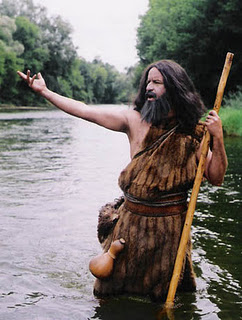
John the Baptist’s message is great for this week between Christmas and New Years.  He calls us back to a simple life-style. After all the feasting we may need repentance.

John the baptizer appeared in the wilderness, proclaiming a baptism of repentance for the forgiveness of sins.  And people from the whole Judean countryside and all the people of Jerusalem were going out to him, and were baptized by him in the river Jordan, confessing their sins.  Now John was clothed with camel’s hair, with a leather belt around his waist, and he ate locusts and wild honey. (Mark 1:4-5)

The wilderness in Scripture was not some beautiful garden-like place where people went on vacation.  Wilderness was wild, uncivilized, stripped of all niceties and refinement.  Israel had spent forty years in the wilderness during the Exodus to purify themselves from all the toxic Egyptian cultural practices. It was a place for spiritual death and rebirth.

John’s clothes of camel’s hair and leather belt, reminded the people of the Old Testament prophet Elijah (2 Kings 1:8).  Sort of like wearing a red cape to remind people of Superman. But John/Elijah had a stronger purpose than Superman, to call the hearts and lives of people back to God.

John called people to recalibrate their vision of life, success, and values.  They were baptized as a cleansing of their sinful ways so that they could begin anew, fresh and clean.

Now as 2011 concludes, we can come to our Lord seeking a fresh beginning, a new start in 2012.  We can confess our sin, knowing that God forgives us our sin and will give us a clean start.

Try this the next time you take a bath or shower.  As you wash the sweat and dirt of the day, say to yourself as you pray to God, “I am cleansed, body, mind and spirit, by the power of the Holy Spirit.”  Then step out into the promise of vibrant new life in Christ. Resolve to act as a child of God, seeking God’s path this day.

Lord Jesus, cleanse me and make me new.

Beginning the Gospel School

Beginnings need special attention. On the first day of school I would wait with my children at their bus stop and snap a picture to mark the occasion. My first day at Resurrection, I arrived early in the morning and walked the grounds, thinking and praying for the congregation’s future. Our western culture declares a holiday to begin each New Year. The Bible starts with the awesome statement, “In the beginning, God created the heavens and the earth.”

The New Testament begins with four gospels, each declaring Jesus Christ as Lord, but in unique ways. Matthew begins with the genealogy of Jesus, showing his Jewish heritage through Abraham and David. Mark begins with the words of the Old Testament, “I am sending my messenger ahead of you,” an introduction to John the Baptist and Jesus’ baptism. Luke begins in the temple of Jerusalem where an angel announces to the priest Zechariah that in his old age he will have a son, John the Baptist. John has perhaps the most auspicious beginning, directly echoing the words of Genesis, “In the beginning was the Word, and the Word was with God, and was God.”

All four Gospels want to make clear from the beginning that Jesus is a central actor of God’s ongoing story to redeem a corrupt and broken world. The story of the Old Testament set the stage for Jesus’ entrance into the cosmic drama. His entrance shifts the story in a radical new direction, but it is still connected to God’s ongoing redemption.

Matthew, Mark, Luke and John are called Gospels (Good News) and not biographies. Their purpose is not simple to inform the reader about Jesus’ life, but rather to transform the reader into a passionate follower of Jesus. They make no claim to be unbiased. They have an announcement to declare: Jesus is Good News for those who embrace his mission.

As 2012 begins, I pray that you will embrace this news and seek to follow Jesus as you read from the Gospels. At Resurrection, our Sunday morning Bible texts will be from the Gospel of Mark and we will follow Jesus chapter by chapter to his death on Good Friday and his resurrection on Easter. Good news is coming in 2012 as we begin our study of Jesus.  Let’s start with joy.

Lord Jesus, show me the way.


Christmas Light

Christmas Eve may not be cute, but it certainly can be magical. One of my deepest memories of Christmas Eve was driving to candlelight worship while listening to the Apollo 8 astronauts, who were circling the moon, read from the first chapter of Genesis: In the beginning God created the heaven and the earth.  I remember looking up an the moon and thinking of the light of God coming for us.  The mystery and wonder of that night changed how I look at the world.

And God said,” Let there be light;” and there was light. And God saw that the light was good: and God separated the light from the darkness. (Genesis 1:3-4)

This evening at Resurrection Lutheran Church we had candle light at worship as we sang “Silent Night, Holy Night.” And once again in the golden glow of awed faces, the Christ child was born into our lives. He brings the magic of hope, the promise that he will rescue us from sin, Satan and death. Thanks be to God.

Lord Jesus, be the light of my life once again.

Christmas Cute?

“It is indeed annoying to our nature to see God Himself take on this poor, feeble, and corrupt human nature, and disdain the holy, glorious, angelic nature.” – Martin Luther

Sometime we push the cute button of Christmas. We think it’s cute that God would want to become a human baby like us. And since babies are always so cute, then the idea that God became a baby must be cute. We paint Christmas in a wondrous glow of beauty.

We forget that God was already beyond any description of cute, beautiful or wondrous. God chose to sink down into our corrupt nature and experience the wretched brokenness of our human nature. We might like to think that we climb up the moral ladder of human achievement to meet our God. Nothing is further from the truth. God came all the way down the cosmic ladder to meet us in our poverty and desperate need, in the darkness of night.

And the word became flesh and dwelt among us, full of grace and truth. John 1:14

Jesus birth is more than cute. It shatters the heavens and bridges the gap between God and humanity. Prepared to be awed by God’s dramatic entrance into the story of our rescue.

Lord Jesus, come.