Wild Life Encounters

Wild life abounds in Rocky Mountain National Park.  In the high country I enjoyed the fat marmots sunning themselves on exposed boulders while small pikas scurried around beneath them.  There were some large falcons circling on the heat thermals each afternoon and one trail was closed due to an aggressive raptor in the area.  On my recent trip, two wild life encounters stand out.
Estes Park Elk

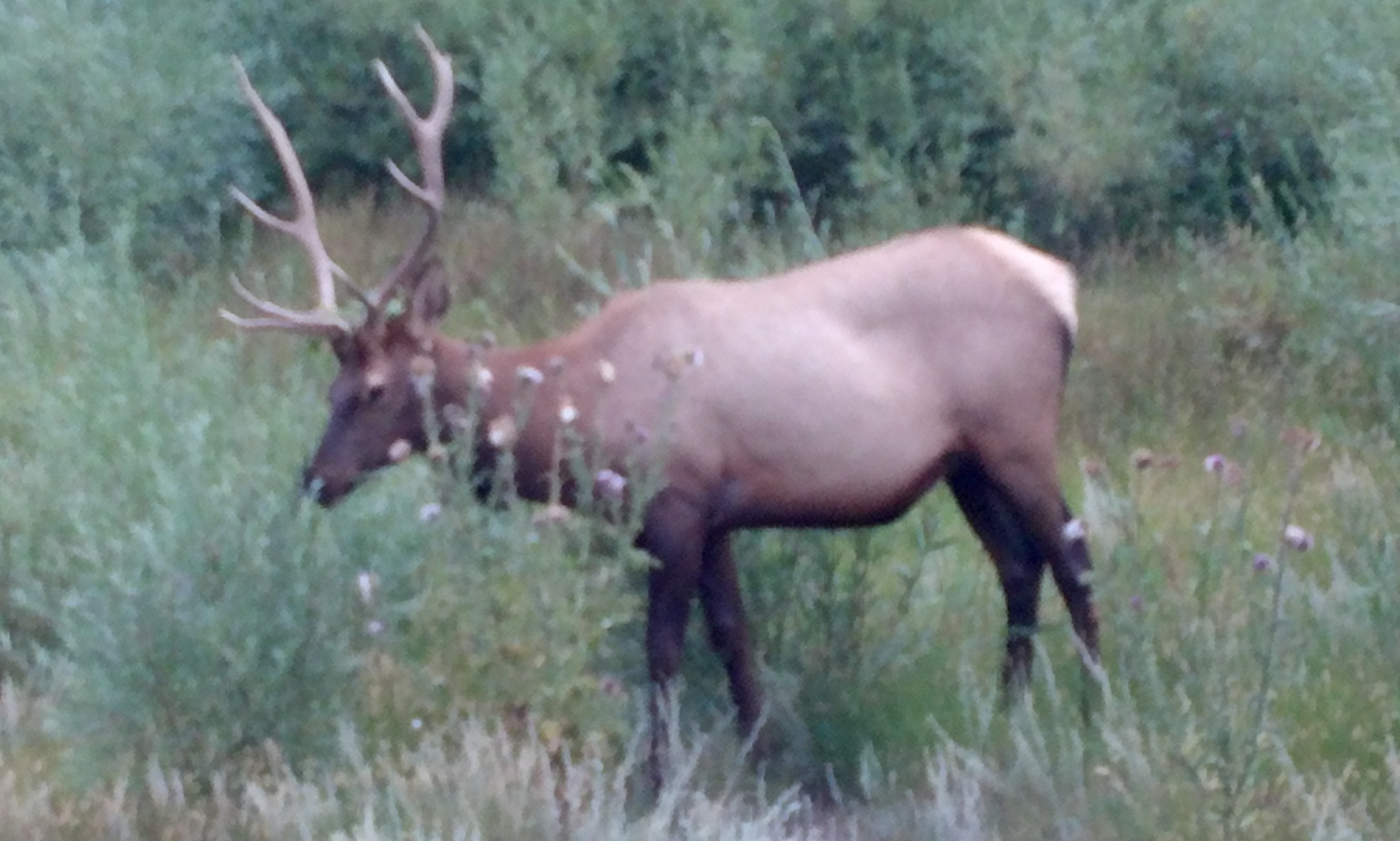
First was an elk.  I was bicycling an Estes Park city trail one evening when I  was surprised to spot an elk only a few feet from the trail.  He was enjoying an evening meal and had no problem with me stopping and taking his picture.   Later I learned that elk are prevalent in Estes Park as fall approaches.  The residents consider them a sign of the changing season.

My second encounter was late at night.  I had placed all my campsite food inside my car, except for my ice cooler.   I figured that no chipmunk or squirrel would be able to open my cooler.  At 11:30 pm I was awaken from a sound sleep by a crash outside my tent.  I quickly grabbed my flashlight and poked my head from the tent.  The cooler was on the ground, its contents strewn across the campsite.  I stepped outside the tent and then spotted the two yellow orbs and the big brown shape staring back at me about 10 feet from the cooler.  A bear had entered my campsite.

For nearly a minute we stared at each other.  He (or she) made no moves towards the cooler or me.  I stepped back to my car and open the car door for a quick exit, but the bear still did not move.  I slammed the car door in hopes of frightening the bear.   The sound startled the bear and it took a few steps back. After a second, louder car door slam, the bear turned and dashed off into the woods.  After waiting a few minutes, I gathered up all the food from the cooler and repacked it before placing it inside the car trunk.  I did take some deep breaths and contemplated calm images prior to falling asleep again.   The next morning I discovered an empty tortilla wrapper; the bear had found something to eat.

The two encounters started me thinking about how people might encounter God.  On the one hand we might think of God as a sign of the season, a kind of wild pet that comes and goes as it pleases, of which we occasionally make sightings. Such encounters seem safe and calming, but they rarely change our behavior or lifestyle.  The second encounter was more disruptive, more awe-some.  It reminded me that God is GOD ALMIGHTY, and that awe and fear can be  appropriate responses to a God-encounter.   Such encounters can change our behavior. I kept the cooler locked in the trunk after that night.

God is the Almighty, Ruler of heaven and earth.  When the Israelites confronted God on Mt. Sinai, they were terrified and thought they would die.  “For who is there of all flesh that has heard the voice of God speaking out of fire as we have, and remained alive?”  (Deut. 5:26)  I fear that we might have turned God into our manageable pet, rather than seeing God as the awesome Creator of the Universe.  Perhaps we need a crash at midnight to wake us from our spiritual slumber.

In what ways is God “wild” to you?

Almighty God, break into my life with all your power and glory that I might see you as you truly are.

Mountain Guide

First, I want to thank Sarah Storvick for being my guest blogger last week.  I appreciate her thoughtful reflections on participation in a “fake” book club and our call to be authentic followers of Jesus Christ.  I am so thankful for having gifted co-workers to share the call to trust, live and serve.

Pastor John Atop Hallett's Peak in RMNP

Second, I am thankful for a refreshing vacation.  I had some great hikes in Rocky Mountain National Park, including the top of Hallett Peak on the Continental Divide.  While atop the peak, I met a volunteer ranger named John. He named all the surrounding peaks for me and told me stories of some of his past hikes and climbs.  He was carrying an ice axe which was not needed on the hike up.  He informed me that he was planning to descend via Andrew’s glacier, an alternate return route that I had been considering.  But seeing his ice axe caused me concern since I did not carry one.  I asked, “Do you think I could descend the glacier without an ice axe?”

He responded,  “I honestly don’t know, but you are welcome to follow me and together we can find out.”

Ranger John preparing to descend Andrews Glacier

Ranger John lead me across the boulder-strewn divide to Andrew’s Glacier and there he stopped to attach some light hiking crampons to his boot. He then directed me on the best angle to descend the ice field and how to navigate beyond the small lake at the glacier’s bottom.   His guiding presence gave me peace and confidence through some tricky parts.

Shortly after John and I parted, I wondered if I would have been as patient and caring to a fellow hiker?  Ranger John certainly was enthusiastic about hiking and proud of the many hidden splendors of Rocky Mountain National Park.  He was a natural evangelists for the park and especially the back country.  Am I as enthusiastic about my journey with Jesus Christ and the high country through which he guides me?  Are you?

Jesus said to them, “Follow me and I will make you fish for people” (Mark 1:17).

Lord Jesus, guide me this day along the path you have given to walk.  Prepare me to be companion guide for the people I meet.

Follow Me

I was talking to my husband about this week’s calendar, and whether I could fit a book group gathering into the schedule. From the back of the van came this question, “Do you guys even read?” My son’s question came from a misunderstanding, but it also contained a lot of truth. Some of the women in this group read the books, others don’t. Each meeting seems to have fewer minutes of book talk and more conversation about children, school, work, and well, life. One member’s son calls it her ‘fake book group.’ I know it’s not the only area of my life where I describe myself one way, but the reality behind the words is something else.  

From that time on, Jesus began to show his disciples that he must go to Jerusalem and undergo great suffering at the hands of the elders and chief priests and scribes, and be killed, and on the third day be raised. And Peter took him aside and began to rebuke him, saying, “God forbid it, Lord! This must never happen to you.” But he turned and said to Peter, “Get behind me Satan! You are a stumbling block to me; for you are setting your mind not on divine things but on human things.”

Then Jesus told his disciples, “If any want to become my followers, let them deny themselves and take up their cross and follow me. For those who want to save their life will lose it, and those who lose their life for my sake will find it. For what will it profit them if they gain the whole world but forfeit their life? Or what will they give in return for their life.   Matthew 16:21-26

In The Message Bible, Jesus tells Peter, “You have no idea how God works.”  And to the disciples, he says, “You’re not in the driver’s seat; I am.”

How much am I like Peter? He’s just been named the rock on which Christ will build his church, and is now struggling to grasp Jesus’ purpose. Can I grasp what it means for Jesus to be God’s son, in all that demands? When I say I am a follower of Jesus, how might that perceptive voice from the back of the van call me out?

Peter is all of these things – faithful, friend, flawed, foundation, follower. What does his story teach us?

Lord, help me to follow you.

 (Guest blogger Sarah Storvick)

Searching for Treasure

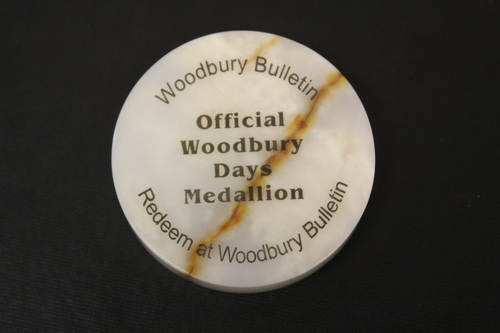
This absolutely gorgeous summer day is distracting me, and my mind wanders, trying to figure out how I can squeeze in a little park hike to search for the Woodbury Days medallion. 

Most summers, at least one of our kids and I have spent a little time pondering the clues, poring over area maps, and wandering around area parks. Though we’ve never found the medallion, we’ve searched in (almost) the right places. Fond memories were made as we enjoyed fun time together, trying to get the most out of the last weeks of summer. This year, however, we haven’t yet made it past reading the clues.  Older teens, perhaps. 

It’s not just the weather that makes me want to hit the trail. I also just want to say that I’ve tried, and successful or not, the search is usually the best prize to come out of the adventure. The same is true of whatever I look for in my walk with God. I can spend a fair amount of time thinking about my search . . . wishing for more focused time in God’s word, thinking about where best to serve God’s world, watching for more direct signs from my heavenly father.  It’s when I grab the map and go that the search gets interesting. Whether I find what I set out to discover, or not, I’m glad for the time spent on the trail, with other seekers. And I usually find treasure–rarely what I was expecting. In much the same way that time with my kids was the real prize in past medallion hunts, the rewards for my faith wanderings are not necessarily what I was hoping to find, but thankfully, the ones God knows I need. 

Every generous act of giving, with every perfect gift, is from above, coming down from the Father of lights, with whom there is no variation or shadow due to change.  James 1:17

What clues are calling to you? What medallion are you seeking? 

(guest blogger Sarah Storvick)

Thank You

This fall our congregation’s theme will be: Generous Living: Responding to God’s Abundance.  One generous response to God’s abundance is to develop a heart of gratefulness.  I am grateful for the wonderful people of Resurrection and the opportunity they give me to be on vacation.   I am also thankful that Sarah Storvick, my capable colleague in ministry, will provide some guest post on this blog next week (if technical challenges allow)> 

A part of my relaxation is rereading Wayne Muller’s book, Sabbath,

Meister Eckhart, the Christian mystic, asserted that if the only prayer we ever prayed our whole life was “Thank you,” that would be enough.  Gratefulness cultivates a visceral experience of having enough.  When we are mindful of what we have, and give thanks for the many gifts we have overlooked or forgotten, our sense of wealth cannot help but expand, and we soon achieve a sense of sufficiency we so desire.  Practice thanksgiving before meals, upon rising, when going to sleep.  Friends, family, food, color, fragrance, the earth, life itself — these are all gifts, perfectly gratuitous.  How can we not give thanks?  During Sabbath time we are less concerned with what is missing, focusing instead on sharing our gratefulness for what has already been given (p. 128).

And whatever you do, in word or deed, do everything in the name of the Lord Jesus, giving thanks to God the Father through him.  Colossians 3:17

Here is a spiritual exercise worth doing every month.  Take a blank piece of paper and make a list of 100 people/things/experiences for which you are thankful.

Thank You, Lord.

From Absurd to Obedient

Peace like a River in Colorado

I am on vacation this week, seeking rest and renewal.  I prepared this post before I left, but it contains my hope for this time away.

Wayne Muller, in his book Sabbath, writes about Henri Nouwen.

Henri Nouwn was a dear friend of mine, a brother, priest, mentor.   He was also a fiercely astute observer of our worried, overfilled lives.  Henri insisted that the noise of our lives made us deaf, unable to hear when we are called, or from which direction.  Henri said our lives have become absurd — because in the word absurd we find the Latin word surdus, which means deaf.  In our spiritual lives we need to listen to God who constantly speaks but whom we seldom hear in our hurried deafness.

On the other hand, Henri was fond of reminding me that the word obedient comes from the Latin word audire, which means “to listen.” Henri believed that a spiritual life was a pilgrimage from absurdity to obedience — from deafness to listening.  If we surrender fully into Sabbath time, we can slowly move from a life so filled with noisy worries that we are deaf to the gifts and blessings of our life, to a life in which we can listen to God, Jesus, all the Buddhas and saints and sages and messengers who seek to guide and teach us.

The world seduces us with an artificial urgency that requires us to respond without listening to what is most deeply true.  In Sabbath time, we cultivate a sense of eternity where we truly rest, and feel how all things can wait, and turn them gently in the hand until we feel their shape, and know the truth of them.

The theology of progress forces us to act before we are ready. We speak before we know what to say. We respond before we feel the truth of what we know.  In the process, we inadvertently create suffering, heaping imprecision upon inaccuracy, until we are all buried und a mountain of misperception.  But Sabbath says, Be still. Stop.  There is no rush to get to the end, because we are never finished.  Take time to rest, and eat, and drink, and be refreshed.  And in the gentle rhythm of that refreshment, listen to the sound the heart makes as it speaks the quiet truth of what is needed. (p.85)

Lord Jesus, teach me to listen.

Seeking Joyful Rest

Leslee Donovan Painting

As I leave on vacation, I am reflecting on this painting by Leslie Donovan, a talented member of Resurrection.  The simple joy of children being together is what I think vacation and Sabbath are all about.  The children are smiling as they prepare to share a meal together.  The painting invites me to share in that joy and to be present in the moment.  I am encouraged to be at peace in the simple pleasures of life.

God gave us the Sabbath for our benefit.  It is  a means to restore and revive us in our relationships with God, others and creation.

Remember the Sabbath day and keep it holy.  For in six days the Lord made the heavens and the earth, the seas and all that is in them, but rested on the seventh day; therefore the Lord blessed the Sabbath day and consecrated it (Exodus 20:8,11)

Wayne Muller has written an excellent book called Sabbath: Finding Rest, Renewal, and Delight in our Busy Lives.  In a chapter called “A New Beginning” he writes,

The ancient rabbis teach that on the seventh day, God created menuha — tranquility, serenity, peace, and repose — rest, in the deepest possible sense of fertile, healing, stillness. Until the Sabbath, creation was unfinished.  Only after the birth of menuha, only with tranquility and rest, was the circle of creation made full and complete. (p. 37)

This week I am seeking the menuha, the peace of God.

How do find rest?

Lord Jesus, grant me rest in you.

Hiking with Suzanne and with Jesus

I am looking forward to my two-week vacation, starting next Monday. The second week will be traveling out to Estes Park, Colorado, to bring daughter Suzanne home from her summer job as a pastry chef at Lane’s Guest Ranch . I am going out early to do some hiking and camping. The mountain trails in Rocky Mountain National Park stir my soul and challenge my heart, lungs and legs.  Mountain hiking is true Body/Mind/Spirit exercise for me.

Suzanne Climbing the Path

I often associate Suzanne with Rocky Mountain National Park, not only because she has worked there the past three summer. In 1996 my wife’s family had a reunion at nearby YMCA of the Rockies. Most of the week was cool and cloudy with frequent rain showers. One afternoon Suzanne and I took a special hike together. We climbed a small prominent peak near the camp and contemplated the vista. I remember the hike well, because I marvel at Suzanne’s ability to hike in spite of her open heart surgery five years before. She was a trooper and celebrated the climb with a shout of victory and a granola bar.

Climbing a mountain is one of my favorite metaphors for the Christian life. Our path in life is often uncertain and challenging. We may only be able to see the next few steps. We persevere through blown down trees or muddy streams. Life in Christ often has its challenges. The path may be steep and long. Still we trust the path will eventually lead us to our goal. As we climb higher our vista opens and we experience the joy and wonder of God’s creation and majesty.

Jesus said, “I am the way, the truth and the life” (John 14:7). The psalmist sang, “Your word is a lamp for my feet, a light for my path” (Proverbs 119:105).

How would you describe your recent path with God?

Lord Jesus, be my guide this day as I seek to follow your path for my life.

Facing the Monsters of Our Life

A Teaching Story from R. Wayne Willis.

There’s an old Egyptian story about a little boy named Miobi who came to a village where the people were very strange. They did little more than moan and groan about almost everything. The fires didn’t get lit, the goats didn’t get milked, the children didn’t get clothed, and the crops didn’t get planted, all because the villagers were expecting any time to get eaten by the monster that lived on top of the mountain.

Miobi looked up, and behold — the monster was real. He had a head like a crocodile and a body like a hippopotamus and a tail like a very fat snake. Smoke and fire came from his nostrils. The villagers lived in dread that any day the monster might come down and devour them.

Miobi said to the villagers, “I will go up the mountain by myself and challenge the monster.” The villagers pleaded with him not to go, sure that he would never return. Miobi began to climb the mountain, and as he climbed higher and higher and got nearer and nearer, the monster looked smaller and smaller. “This is a very curious phenomenon indeed,” thought Miobi. “When I run away from the monster, the monster gets larger, but the nearer I get to it, the smaller it becomes.”

When at last Miobi reached the cave, instead of a gigantic monster, he found a quiet little creature about the size of a toad. It purred. Miobi picked it up and put it in his pocket and headed back down the mountain.

When the villagers saw Miobi safe and sound, they wanted to make him their god for slaying the monster. Miobi explained exactly what had happened and how he had brought the “monster” back down the mountain as a pet. He showed them the little-toad like creature. “What is your name?” the villagers asked. The monster answered, “I have many names. Some call me famine, and some pestilence; some call me war, and some cancer.” Then the little creature yawned and added, “But most call me What Might Happen.”

— R. Wayne Willis in Hope Notes

How do you face “what might have been?”

“Be strong and courageous, do not be frightened or dismayed, for the Lord your God is with you wherever you go.” Joshua 1:8

Lord Jesus, give me courage to face “what ever comes” with you.

Cornfields, Pumpkins and Worship

Cross and Corn

My daughter, Christina, is home from her college in Pennsylvania and worshipped at our outside service on Sunday.  She commented afterwards, “It is so amazing having worship beside a cornfield.”  She went on to say that many of her eastern classmates think Minnesota is covered with cornfields, so our worship reinforced that stereotype. I reminded her that just north of Bailey Road is a golf course and thousands of suburban homes.  Still the cornfield stands out.

Perhaps the cornfield can serve as a symbol of the vibrant life in Christ.  Jesus often used the image of seeds to communicate the growing aspect of our life in him

Very truly, I tell you, unless a grain of wheat (or corn?) falls into the earth and dies, it remains just a single grain; but if it dies, it bears much fruit. John 12:24

The cornfield also reminds us that we are called to grow together.  The cornstalks are stronger and more resist to wind if they grow in a field together.  Yet each cornstalk is unique in it height, breadth and yield.  We are all unique creations of God, wired with our own dependable strengths, passions and callings.

The cornfield also connects us to a key petition of the Lord’s Prayer, “Give us today our daily bread.”  God uses the farmer, millers, bakers, merchants, and financiers to move the corn in the field to the food on our table.   We can be thankful not only for the food but for all the people who work to feed us.

Scott H tilling the soil

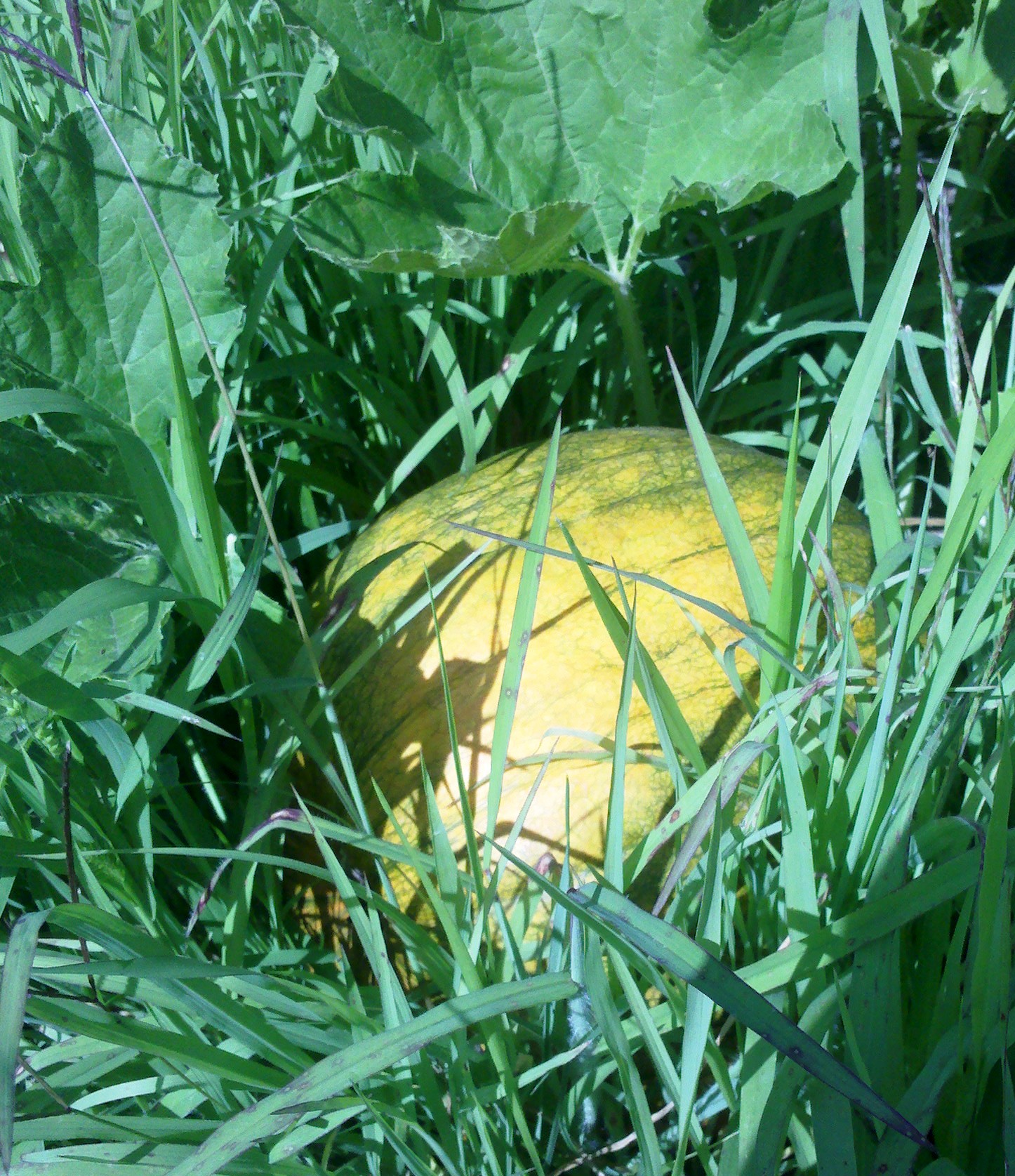
Near the cornfield is the pumpkin patch that our church is  utilizing to grow pumpkins for our harvest festival in October.  Scott Hanson is working the field, trying to keep the weeds down and the vines growing.  It is truly amazing to watch how the vines in such a short time have covered the field.   Pumpkins are rapidly growing into ripe fruit.  I am reminded that God first put Adam in the garden of Eden to till and keep it (Genesis 2:15).   Our patch may not be Eden, but it is direct descendent.

How do you celebrate the wonder of summer growth?

Early Pumpkin

God of the harvest,
I celebrate the earthiness of potatoes just dug up, 
the sweetness of corn,
the
 beads of dew on tiny gourds,
the orange glow of ripe pumpkins,
green cucumbers and zucchini,
the garden full of life, health and bounty.