Author Archives: John Keller

Unknown's avatar

About John Keller

I am a retired Lutheran pastor whose intention is to consent to God's gracious presence and actions within.

Hooked on Backpacking

Marymere Falls. Photo by C. Bubar/NPS

My dad was leading our family on a short one mile nature hike to Marymere Falls in Olympic National Park. The trail was near my childhood home of Port Angeles, Washington.   I was about seven years old and enjoyed racing ahead of my younger siblings.   I sometimes hid along the trail in an attempt to scare them.   It is no wonder therefore that in the confusion of children running up and down the trail, we missed a critical trail junction and plunged deeper into the forest of Barnes Creek.

We probably went an extra mile or so with no sign of Marymere Falls.  As a child I thought we were deep in the jungle, all alone.   Then around a corner came three individuals, carrying large bundles on their backs.   They told my dad that he had missed the junction and that we should probably turn around.   “The trail gets pretty rugged up ahead.”   In a moment, the three were gone.

A more recent backpacker

But their memory stayed with me.   I asked my dad what they were doing.  “Oh they were backpacking.  Did you see those large packs?   They carried all their own food and tents to stay in the mountains.”   Wow, I thought.   To camp out in the woods, far from roads and car campgrounds –that is a real adventure!

Ever since that hike, I wanted to go on a backpacking trip in the mountains.   Then in the spring of 1969, a high school  friend invited me on a trip to Lena Lake in the Olympics over Memorial Day week-end.  I immediately said yes.   Even though it rained the entire two mile hike to Lena and I was soaked to the bone, even though I had a borrowed pack that did not fit me, and even though I made a fool of myself trying to light a fire, I fell in love with backpacking.  I experienced a sense of place and belonging.   I was hooked.

Over the decades I have completed scores of overnight backpacks, each unique and rewarding.  Last year I blogged about completing a section of the Pacific Crest Trail in northern Washington state.   Tomorrow, I start another hike along a section in southern Washington.

Mt. Adams and Goat Rocks Wilderness are part of the trail this year.

Backpacking has become a kind of spiritual refuge for me, a time and method to be centered in God’s grace and love.  I am reminded of one on my favorite prayers from the Lutheran Book of Worship:

Lord God, you have called your servants
to ventures of which we cannot see the ending,
by paths as yet untrodden,
through perils unknown.
Give us faith to go out with good courage,
not knowing where we go,
but only that your hand is leading us
and your love supporting us;
through Jesus Christ our Lord. Amen.

I will be carrying good maps (and an extra pair of glasses – see here) so I don’t expect to become lost.  But if I do, I am confident that God will provide me with three strangers to guide and inspire me, just like he did years ago on the trail beyond Marymere Falls.

Where do you find your spiritual refuge?

Lord Jesus, guide us.

Healing at the Center

Centering Prayer is saving my mind while healing my soul.

IMG_20140812_190249_047-EFFECTS

St. Paul Monastery in Minnesota

I just returned from a five-day silent retreat at the St. Paul Monastery.  I practiced Lectio Devina (a form of prayerful reading and conversation).  I was familiar with the practice – we use a form of it during our staff meetings at Resurrection – yet the monastic practice strengthened my love of God and God’s Word.

Jesus in the Center of Prayer

Jesus in the Center of Prayer

However the most profound part of the week was the practice of Centering Prayer.  Each morning at 7 am we sat together for an hour simply breathing and praying our holy word.  We repeated it again at 10 and at 3.  Too many it sounds incredibly boring.   For me, it was drinking from the river of the water of life (Revelation 22:1).   It was simply resting or floating in God’s gracious love. Emptying the mind so God’s love could fill it.  Not just thinking about God’s love, but actually resting in it.

Oh, my mind fought the emptiness.  My thoughts and feelings would race from one idea to the next.  The river seemed to be covered with all kinds of flotsam and debris.  “What is happening at church?”  “Why did I say that to her?” “What will we have for lunch.” This would happen hundreds of time during the quiet.   Each time I caught the thought skipping across the surface, I let it go and return to my breath and my word.  To simply BE in God.

Henri Nouwen wrote in Here and Now, 1994

The real enemies of our life are the “oughts” and the “ifs.” They pull us backward into the unalterable past and forward into the unpredictable future. But real life takes place in the here and the now. God is a God of the present. God is always in the moment, be that moment hard or easy, joyful or painful. When Jesus spoke about God, he always spoke about God as being where and when we are. “When you see me, you see God. When you hear me you hear God.” God is not someone who was or will be, but the One who is, and who is for me in the present moment. That’s why Jesus came to wipe away the burden of the past and the worries for the future. He wants us to discover God right where we are, here and now.

Centering prayer is a form of mindfulness practice, living in the current moment.

Fire Creek was ablaze with color.

At times I missed the beauty that surrounded me

I discovered my real need for this last summer when I was backpacking on the Pacific Crest Trail.   I had looked forward to the trip for months and was in absolutely beautiful alpine country, yet my mind kept racing back to worries in Minnesota or to past actions that I regretted or wished I could change.   Here I was in the place I wanted to be, and my mind could not stay there!    I knew I needed help.

This past spring I took Mindfulness Based Stress Reduction class which is a secular form of Buddhist meditation practices.  It was incredibly helpful.  The Centering Prayer has similarities to meditation, yet centers the practice in the love of God in Christ Jesus.   That has been healing.

Now next week, I head back out to Washington state to do another section of the PCT.  I will continue my practice of Centering Prayer and Lectio Devina.  I trust that my mind will be able to stay on the trail with my body this year.

How does prayer touch your life?

Lord Jesus, teach us to pray.

Judging First Impressions

First impressions get me into trouble.  Does that happen to you?

Copyright:'http://www.123rf.com/profile_dolgachov'>dolgachov / 123RF Stock PhotoWhen I meet someone for the first time, I often make some snap decision regarding them based on their handshake, body size, facial expression, and or taste in fashion.  It sometimes feels like I am giving an instant “thumbs up” or “thumbs down” judgment before any word is spoken.  Such snap decision can then color how my conversation goes with the person and what I think of them.

And a big part of my problem with this is that I don’t even realize that I am doing it!

Jesus’ words, “do not judge, lest you be judged” (Matthew 7:1) are a clear warning for me to examine my judgmental character.   And his story about the Pharisee and the Tax Collector highlights how as a religious person I can easily judge others.

 “Two men went up to the Temple to pray, one a Pharisee, the other a tax man.  The Pharisee posed and prayed like this: ‘Oh, God, I thank you that I am not like other people – robbers, crooks, adulterers, or, heaven forbid, like this tax man.  I fast twice a week and tithe on all my income.’  “Meanwhile the tax man, slumped in the shadows, his face in his hands, not daring to look up, said, ‘God, give mercy. Forgive me, a sinner.'”  Jesus commented, “This tax man, not the other, went home made right with God. If you walk around with your nose in the air, you’re going to end up flat on your face, but if you’re content to be simply yourself, you will become more than yourself.” (Luke 18:10-14, The Message)

My first step in becoming less judgmental is first to recognize that I am doing it all the time.   I judge in the morning whether I like or dislike the weather outside my window.  I judge whether my breakfast is tasty, my coffee is too cold, or my attitude is too cranky.  Mindfulness meditation has helped me to see that these judging thoughts are simply that: thoughts or feelings that are not always reality.

Now when I recognize a judging thought,  I simply observe it and note its existence.  I may investigate to see what its history and/or cause may be.  Then I can decide whether I want to hold on to it or let it go (in a sort of non-judgmental way).

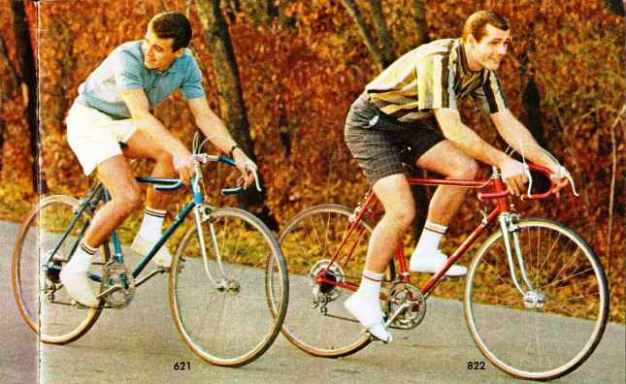
For example: I met up with some of my buddies for a bike ride and a new person is there whom I have not met.  I might scan their bike and see how new and/or what make it is as a way to size up what kind of cyclist they may be.   I look at what clothes they wear and how fit they appear.   These first impressions all take but a few seconds, but they can easily color my opinion of the n1964_schwinn_varsity_super_sportew person.

If I were to stop and investigate these impressions, I would remember how I felt when I had an old Schwinn ten speed bike and rag-tag cycling gear.  Also I would remember cycling with people who did not look fit yet could easily outride me.  I recognize these “judgments,” and their accompanying feelings, then set them aside as I introduce myself to the new rider.   Who knows, they may become a new friend.

Here is a link to a video that describes non-judging from a mindfulness training perspective.

How do you live out Jesus’ words, “judge not”?

Lord Jesus, grant me grace to see each person, each moment, as a gift from you.

Non-striving Grace

I strive to do well yet my striving often brings me grief and disappointment. When I train to run a marathon, I find myself striving to practice hard, only to become injured and unable to reach the starting line. In preaching, I strive to preach a perfect sermon, only to discover that I have frustrated myself and the congregation.  Or when I rush to make a blog post and my wireless network crashes, I feel frustration.  The constant hum of push, push, push, wears me down.

TSBB_Frustration-440x293

Last summer I was backpacking in the mountains, a trip I had anticipated for months.  Yet I frequently found my mind striving and shifting to somewhere else.   I found it extremely hard to simply BE in the moment.  My mind kept jumping to some other place and time.

IMG_20130816_105142_210Is “push, push, push, strive, strive, strive” the center of the Christian gospel? Is constant striving to do more, to do better, and to do all, is that living by grace? Doesn’t God’s grace free me from such obsessive striving?  Doesn’t God’s peace allow me to simply be in the present moment?

In my recent study of mindfulness training, one central is non-striving. Being able to accept what my limits are in body, mind and spirit has had a freeing aspect for me.  Non-striving has been a word of grace for me.  Below is a you-tube video that explains non-striving in a grace-filled way.

The peace of God which surpasses all human understanding guard your hearts and minds in Christ Jesus.  Phil 4:7


Living Grace

Baptized and raised in the Lutheran church, I have heard the word “grace” all my life.   I learned that grace is God’s unconditional love. We are placed in a right and loving relationship with God not by our moral actions or good work, but by God’s gift of grace through Jesus Christ as I trust in God’s promise of grace.

As a young adult I memorized Ephesians 2:8-9: For by grace you have been saved through faith, and this is not your own doing; it is the gift of God—not the result of works, so that no one may boast.   

Though I intellectually understand this, I don’t fully live into it.  Like many Americans I have grown up with the central concept of doing, striving and accomplishment – that I must work hard to get anywhere in this world, even in the church or with God.   The idea that I can live, breath, and experience grace as a daily gift is challenging for me.

Frederick Beuchner expands my images of grace in his book, Beyond Words (2004).

raspberries-and-cream-bpGrace is something you can never get but can only be given. There’s no way to earn it or deserve it or bring it about any more than you can deserve the taste of raspberries and cream or earn good looks or bring about your own birth.

A good sleep is grace and so are good dreams.  Most tears are grace. The smell of rain is grace.  Somebody loving you is grace.  Loving somebody is grace.  Have you ever tried to love somebody?

A crucial centrality of the Christian faith is the assertion that people are saved by grace.  There’s nothing you have to do. There’s nothing you have to do. There’s nothing you have to do.

God created the universe and each of us as a gift of grace.

God created the universe and each of us as a gift of grace.

The grace of God means something like: “Here is your  life. You might never have been, but you are, because the party wouldn’t have been complete without you.  Here is the world. Beautiful and terrible things will happen.  Don’t be afraid.  I am with you. Nothing can separate us.  It’s for you I created the universe.  I love you.”

There is only one catch.  Like any gifts, the gift of grace can be yours only if you’ll reach out and take it.

Maybe being able to reach out and take it is a gift too. (p. 139)

How have you experienced GRACE daily?

Lord Jesus, teach me to live by grace.

Centering Down in Patience

Tuesday morning I visited a centering prayer group in a congregation near my home. I had discovered it on their church website and wanted to practice with them. Centering prayer is a Christian form of meditation in which the purpose is to silently wait in God’s presence. You can read more about centering prayer at http://www.centeringprayer.com.  After taking a Mindfulness Based Stress Reduction Class I wanted to bring my meditation practice into a more explicit Christian context.

Jesus in the Center of Prayer

Jesus in the Center of Prayer

The seven women who gathered together were an eclectic group. They graciously welcomed me. The small chapel had a cross with candles and comfortable chairs for sitting quietly. The group is self-lead and we started with a brief devotional reading about being open to the love of Christ. They read it as a form of Lectio Devina, preparing one’s heart to listen. Then we sat in silent prayer together for about twenty minutes.  I appreciated a deep joy in sharing this time of centering down.

51KNK7QgraLRobert Roberts on his chapter on Patience in his book The Strengths of a Christian writes about how silent prayer is essential to developing the virtue of patience, the art dwelling gladly in the present moment.

Centering down is a matter of purifying your attention, collecting it into a focal point which is the God whose identity is known through Jesus Christ. As such, centering down is the practice of the presence of God and at the same time, the practice of patience defined as dwelling gladly in the present moment.  In centered prayer the individual is “absorbed,” though not in the sense of dissolved, in glad fellowship with God. (p. 73)

When I practice centering prayer I focus on my breathing, using a short prayer like “Jesus is Lord” or simply “Yah-weh” (the ancient Hebrew name for God – I am who I am – Exodus 3) with each breath. “Jesus” on the in breath; “is Lord” on the exhale. Recently I taught our congregation the simple prayer, “Papa is here,” based on the Lord’s Prayer where Jesus used the familiar word “abba” or “papa” in his address of God the Father. The exact words of prayer are not as important as consistent use of heart, mind and breath.

Like all who practice centering prayer, my mind wanders off on tangents and I need to gently bring it back to my breath and prayer. I don’t berate myself about the wandering but rather simple note it and come back to my prayer. I know that God knows my desire is to center on him and I believe He will bless my attempts. Like a good papa, God is patient with us.  Can we be patient with God?

How have you found ways to Center Down in patience?

Lord Jesus, let me be centered in you.

Wedded To a Faithful Grand

Today Carolyn and I celebrate our 37th wedding anniversary.  I wrote about our romance a couple of years ago here. Though we have had our share of struggles, she continues to bring joy and love into my life.

Family Selfie

Family Selfie

One place where Carolyn excels is in her love of family, our children and grandchildren.  When our children were younger, she set aside her career as a pastor to give time and opportunities for our children, Jonathan, Suzanne and Christina.  She made sure our children had the best overall educational opportunities for each child, using a combination of public schools, private schools, public charter school and home schooling to provide the best learning environment for each of our three children.  She served as an informal college guidance counselor as each child flew from the nest to out-of-state colleges.

Grandparents and GrandkidsNow with two grandchildren, she has embraced her new role as “Grand” (grandmother) .  I know people who struggle or even reject the title of grandparent, since they see it as a sign of aging.  Carolyn has embraced her role, savoring every opportunity to interact with Jack and Grace.  I am so thankful that we are able to share in this honor together as grandparents and her devotion continues to teach and inspire me.  She sees this as part of her calling from God, to share the wonder of Jesus Christ with our children and grandchildren.

I am reminded of your sincere faith, a faith that lived first in your grandmother Lois and your mother Eunice and now, I am sure, lives in you.  (2 Timothy 1:5)

Lord Jesus, thank you for Carolyn.

Cultivating Patience

I am in the midst of a preaching series called Foundational Attitudes; Developing the Mind of Christ. Yesterday the attitude was patience.  I Cor 13:4 Love is patient. I shared how my grandson Jack is helping grow in patience. He even taught me how to wait patiently at the doctor’s office prior to his cast being removed.

Jack Waiting Patiently (sort of).

Jack Waiting Patiently (sort of).


Looking back through my blog, I discovered that patience has been a growth area for me.  I have written about patience in several posts:

Patience and beyond January 2011

The Strength of Patience March 2011

The Happiness of Patience March 2011

Waiting for Patience  April 2013

From these it appears that I am a slow impatient learner!

Yet I also realize that patience is cultivated and grown over time.  It is not instantaneous. Yesterday I discussed how we cultivate patience in daily circumstances, with other people and with ourselves. .

Robert Roberts writes about this in his excellent book: The Strengths of a Christian (1984) in which he describes how we cultivate patience with other people – our neighbors in Christ.

Dwelling gladly in the presence of the neighbor does not often, or at first, come naturally to us, any more than dwelling gladly in the presence of God.  The neighbor is almost by Christian definition someone in whose presence it is difficult to dwell gladly.  .  .  . But worse than being boring, the neighbor may be positively repulsive in one way or another or may be in some need that requires attention, time or some kind of sacrifice. (P. 78)


So a peculiarly Christian answer to the question of how one goes about centering on one’s neighbor is this: Remind yourself, when you are impatient, that this is a brother or sister for whom Christ died, one who like you, is precious in the sight of God.  Look at the eyes, the skin, the mouth, and listen to the voice, and remind yourself that this is the flesh that God took upon himself in Jesus.  And so your gratitude to God is summoned up as a power of patience, and thus of love. (p 81)

When have you had to cultivate patience in your relationships with others?

Lord Jesus, teach me to cultivate patience by see you in my neighbor.

Fresh Start

I confess that I often live on autopilot. I wake at the usual time of 6:00 am.  I run the same four mile route most mornings. Afterwards, I heat my milk in the microwave in the same cup and pour in the same amount of instant coffee and creamer. And the day rolls on.

Autopilot is not all bad, but I am discovering that I often use autopilot with people as well. When I greet someone at church or my small group, I exchange the same daily pleasantries, expecting the same answers. I am beginning to realize that I may be “sleepwalking” through much of life.

This month I am embracing the idea of a Fresh Start. It comes from Eugene Peterson’s translation of a familiar verse: 2 Corinthians 5:17.

The familiar NRSV translation is:

So if anyone is in Christ, there is a new creation: everything old has passed away; see, everything has become new!

Eugene Peterson’s The Message is:

Now we look inside, and what we see is that anyone united with the Messiah gets a fresh start, is created new. The old life is gone; a new life burgeons! Look at it!

Morning Yoga has helped me focus on a fresh start

I seek to practice a fresh start each day, aware of the new each moment holds. Part of this fresh start has been using morning yoga as a form of meditation to open my mind, body and spirit.   Like a young child exploring the world, I seek to see a new creation. In Christ I am a new creation, with a new mind and new eyes and ears to experience God’s world.  I want to embrace Peterson’s admonition, “Look at it!”

John Kabat-Zinn in Full Catastrophe Living describes this as beginner’s mind. He writes,

The next time you see somebody who is familiar to you, ask yourself if you are seeing this person with fresh eyes as he or she really is, or if you are only seeing the reflection of your own thoughts about the person, and your feelings as well. Try it with your children, your spouse, friends, co-workers, and even with your dog or cat if you have one. Try it with problems when they arise. Try it when you are outdoors in nature. Are you able to see the sky, the stars, the trees, the water, and the rocks as they are right now, with a clear and uncluttered mind? Or are you actually seeing them only through the veil of your own thoughts, opinions, and emotions. (Fully Catastrophe Living, 2013, p. 24).

The idea of approach each day, each moment, each encounter as a Fresh Start is challenging. I often slip back into autopilot thinking and reacting. Yet each time I slip, I have the opportunity to embrace a new Fresh Start.  Thanks be to God.

How do you respond to God’s invitation to a Fresh Start?

Lord Jesus, open my eyes to see you new each day.

Rejoice in the Lord Always

Yesterday I preached on a favorite verse from Paul’s letter to the church at Philippi, “Rejoice in the Lord always, again I say rejoice” (Phil 4:4).  I memorized the verse as a simple song in high school and I continue to use it as a prayer mantra as a I run.   Joy is an attitude that I seek to encourage in various ways (Four Lessons for Joyful Habits).

Joy is often confused with happiness, but I think there are some critical distinctions.    I used Pharrell Williams music video to help introduce the contrast between happiness and joy.

The video is a lot of fun; various people, in all shapes, ages and sizes, dance to the song.  However I do struggle with one phrase Pharrell makes, “Clap along if you feel like happiness is the truth.”   I wonder how such an ephemeral feeling like happiness can be considered the truth.   Like all emotions, it comes for a brief time and then fades, replaced by another emotion, like disappointment, grief, boredom or anger or contentment.  I think of truth as having a more lasting quality.

Like many emotions it is often triggered by circumstance.  I used a metaphor yesterday in which I described how different people approach a vacation day at a Minnesota lake.  A fisherman is happy with overcast skies, cooler weather and a bit of chop on the water, so the walleyes wouldn’t see the boat.  A water skier likes perfectly smooth water and bright sunshine. And a sailor likes a stiff breeze to fill the sails of the boat.  Each prefers different circumstances to enjoy their sports.  And no one is really happy with a series of violent thunderstorms moving over the waters.

Joy is not dependent on circumstances.  Paul states that we are to rejoice in the Lord.  Joy is the knowledge and trust that I am surrounded and held by God’s grace and love, no matter what the circumstances.   To push the lake metaphor a bit, joy is sinking beneath the surface circumstance (whether bright sunshine or stormy waves) into the peace and calm of Jesus’ love.   The calm, warm water surround and supports us no matter what may be happening on the surface above.

A few verses later Paul reminds the church “The peace of God which surpasses human understanding guard your hearts and minds in Christ Jesus” (Phil 4:7).  God’s peace (and joy) exists in the place beyond daily circumstances.  Contemplative prayer is a way for me to drop below the daily surface circumstance and rest in God’s peace and joy.   I imagine myself floating in the embrace of Jesus’ love, guarded by the promise of God’s Word.

How do you Rejoice in the Lord Always?

Lord Jesus, teach me to find my joy in you.