Category Archives: Uncategorized

The Path of Questions

Winter Wonderland Road by Andrew Young

Often our journey with Christ is like this snowy roadway, uncertain and slippery. We seek certainty and God gives us surprises and questions.

This morning in our Men’s Bible Study as we read Mark 2 and 3 together, I was struck by how many questions Jesus asked:

Which is easier, to say to the paralytic, ‘Your sins are forgiven,’ or to say ‘Stand up and take your mat and walk’? Mark 2:9

The wedding guests cannot fast while the bridegroom is with them, can they? Mark 2:19

Is it lawful to do good or to do harm on the Sabbath, to save life or to kill? Mark 3:4

How can Satan cast out Satan? Mark 3:23

Who are my mother and my brothers? Mark 3:33

I realized that several of these questions are rhetorical in nature. Jesus answered them himself in short order. Still he asked questions to push and to prod his listeners to think about their faith, to consider how their faith in God impacted their lives. The questions are something that we as readers of the gospel should take seriously.

As a pastor I am often asked questions by congregants about current theological issues. Such as, “Must someone confess Jesus Christ as Lord in order to go to heaven?” or “Is the Bible literally true when it says _________________?” I sometime like being the expert, the answer man. It seems to gives me a certain status or recognition. However there is a danger if I answer too quickly. I can possibly cut off the conversation one is having with God, wrestling with the question. The “chewing” on the question can push us to deeper trust and faith in God.

Jesus seemed to recognize this, often answering a question with a question. Clearly he was the “expert” who knew the answer, but he sought a deeper trust relationship with the questioner and also with us, the modern reader.  He showed us that his path is not like a superhighway, but  more often a winding path on a winter’s day.

So pay attention to the questions Jesus asked by asking yourself, “What is Jesus trying to teach me?” 

Lord Jesus, help me not to settle for easy answers, but to trust you to guide my wandering journey.

P.S.  Andy Young is my nephew in Seattle and has a great photo slide show on Facebook.

Social Media Scream and Seeds

Ahhhhhhh by kennymatic
Ahhhhhhh, a photo by kennymatic on Flickr.

Okay, this social media stuff is becoming more of a challenge. I started this blog over a year ago and I have two Facebook accounts (one for family and one for the congregation) and I use my Droid 3 phone to text my daughter and I have dabbled a bit on Twitter and I want our congregational website to be as current as possible and I need to start an on-line newsletter for the members of Resurrection Lutheran and I know that there are technologies that will link this all together and sometime I just want to SCREAM.

Well, maybe “scream” is a bit of an over-reaction, but certainly I am at time overwhelmed by the technological possibilities that have grabbed hold of our society. I could bury my head in the sand (or an old fashion book), but I feel this call to adapt. After all, the message of Jesus Christ is worth spreading out into the world. I remember that the apostle Paul had to adapt as he made his missionary journeys into the Gentile world. His sermon to the people of Athens revealed how he work to understand their culture, their native religiosity, so as to make a connect to the good news of Jesus Christ (Acts 17:22-34). Every age has had to adapt to new technology and culture. I think one of the great strengths of our Christian faith is that it is adaptable to new times and situations, while staying true to our God.

As I write blog posts and try to compose cleaver tweets, I am reminded of Jesus’ parable of the sower (Mark 4:1-20), my sermon text for this Sunday. The sower was pretty wild in his tossing of seed. He seemed to be intent on flinging it everywhere, with the confidence that it will find good soil. As I post, tweet, facebook, e-mail and preach I need to trust in the power of the Holy Spirit, the wind of God, to carry the seed to productive soil, where the fantastic news that we are loved and cherished by God will be heard.

Lord Jesus, send your word on the wind of your Spirit.

Seeds of Vibrant Life

My posts are often inspired by scripture, but occasionally the Holy Spirit works through other mediums. Drew Jonell is a talented artist and photographer who has won awards as a high school student. He is a member of Resurrection Lutheran Church and his photo struck me as an expression of our congregation’s mission statement: to call all people to a Vibrant Life of Faith in Christ.

There are several ways it expresses the Vibrant Life. First, the brilliant blue sky is the source of light. Jesus Christ is our intense blue sky that creates the vibrations and brilliance in our life with Him. The blue sky draws us into the photograph. Jesus Christ draws us into the Vibrant Life.

Second, the drifting clouds, reminds me of the cloud of witnesses who are mentioned in Hebrew’s 12:1. These clouds of witnesses are all saints of God who have preceded us in faith. They now stand in heaven cheering us on in our faith journey. We are not alone in the Vibrant Life.

Third, the seeds being given to the wind are representative of God’s Word giving us strength and hope for the future. The sower sows the Word (Mark 4:14).

Finally the silhouette reminds me that it is the light of Christ which shapes and forms what people see of me. My life is formed by Jesus; I vibrate to his light waves. Without him, everything would be dark or grey. Yet surrounded by him, I am fully alive.

Thanks, Drew, for being inspired to take this photo.

What gives you inspiration for your Vibrant Life of Faith in Christ.

Lord Jesus, continue to sow the Word of life in me.

New Wineskins

C. S. Lewis wrote an excellent book on literary criticism, An Experiment in Criticism, that is applicable to how one reads scripture. Lewis argues that a critic should not take preconceived opinions into the reading of a book, but remain open to receive what the writer brings. Our culture too quickly labels a book as good or bad and that judgment is often based on some arbitrary taste. Lewis argues that a book would be better judged by what kind of response it elicits from the reader. Does the reader cherish the book and want to read it over and over, reflecting on its meaning, prose and insights?

An open stance towards the reading of scripture is even more important. We need to allow our mind to hear the text. We cannot simply make our own quick evaluation of it nor rely on the comments of a biblical commentary. We need to read Luke as Luke and distinguish it from the perspective of Matthew, Mark and John. We need to keep our own evaluation process out of the reading and allow the text to speak to us, on its own terms. In other words, let the text shape and critique me and not the other way around.

This can be challenging since so much of my reading of scripture has been shaped by what others may have taught or preached. I bring my biases and cultural norms that are hard to place aside so that the text can speak. I struggle to be quiet and receptive to what God may say through the Word. Yet as I open myself, trusting the Holy Spirit to work through the text, I discover the life giving Word.

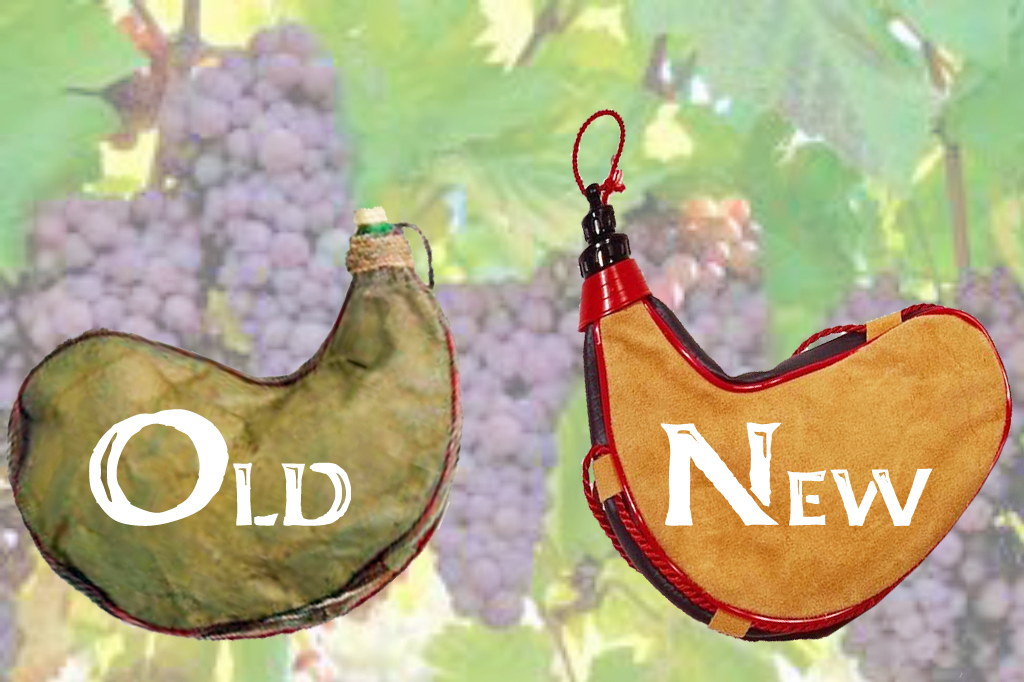
It sort of like Jesus’ teaching that one put new wine into new wineskins, so that as the wine ferments and expands, the wineskin has the flexibility to expand and adapt (Mark 2:22). Old wineskins lack the flexibility to expand and instead burst.  My openness to God’s Spirit allows the wine of the Spirit to expand and shape my wineskin of thought and action. I want to be a new wineskin, receptive to the transforming power of God’s Word. And I pray that my congregation and national church would be new wineskins as well.

How do you stay open and receptive to God’s Word?

Lord Jesus, fill me again with your new wine.

Go Home

What path are you following?

When I read the Gospel of Mark, I am struck by how quickly certain people left everything to follow Jesus. Peter, Andrew, James and John immediately left their fishing nets to follow Jesus (Mark 1:18). Levi left his tax booth and followed him (Mark 2:14). I think to myself, “I could never make such a radical, instantaneous decision like them.” The text helps me examine the depth of my conviction to follow Jesus.

Today I was reading the story of the paralytic in Mark 2. Four friends stopped at nothing to place the paralytic in the sight of Jesus. Their plan was that he would be healed. But Jesus’ home was so filled that they could not enter. They still made a way. Jesus then made the controversial move of saying, “Son, your sins are forgiven.” The religious hierarchy had a fit because they did think Jesus had the authority to forgive sins. Jesus could see their skeptical thoughts so he said something even more troublesome, “Which is easier, to say to the paralytic, ‘Your sins are forgiven’ or to say ‘Stand up and take your mat and walk?’”

That is a question that continues to challenge all who read it. Which would you say is easier to say?

Jesus continued, “I will now demonstrate that the Son of Man has authority on earth to forgive sins.” He turned to the paralytic, “Stand up, take your mat and go to your home.” Those last words caught my attention. I expected Jesus to say, “And follow me.” After all, here is an ideal candidate to follow Jesus. The healed paralytic could bear witness to what Jesus had done for him. He could be living proof of Jesus authority and healing power.

But Jesus sent him home.

I don’t know why Jesus would call fisherman and tax collectors to follow him, and not the healed paralytic. (It could have something to do with whether miraculous healing was to be the primary focus of his ministry.)  Still, there are at least two lessons that we need to hear.

First, our sins are forgiven. Our broken relationship with God is restored by Jesus’ authority.

Second, we need to listen carefully as to where and how we serve. Not all of us are called to serve Jesus in the same way, to walk the same path. Yet I think we all are called to listen to his voice, a voice that speaks forgiveness and direction.

Lord Jesus, open my heart, mind and will to hear your promise and command.

New Year’s with JB

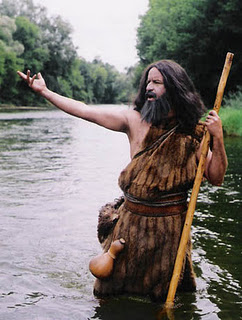
John the Baptist’s message is great for this week between Christmas and New Years.  He calls us back to a simple life-style. After all the feasting we may need repentance.

John the baptizer appeared in the wilderness, proclaiming a baptism of repentance for the forgiveness of sins.  And people from the whole Judean countryside and all the people of Jerusalem were going out to him, and were baptized by him in the river Jordan, confessing their sins.  Now John was clothed with camel’s hair, with a leather belt around his waist, and he ate locusts and wild honey. (Mark 1:4-5)

The wilderness in Scripture was not some beautiful garden-like place where people went on vacation.  Wilderness was wild, uncivilized, stripped of all niceties and refinement.  Israel had spent forty years in the wilderness during the Exodus to purify themselves from all the toxic Egyptian cultural practices. It was a place for spiritual death and rebirth.

John’s clothes of camel’s hair and leather belt, reminded the people of the Old Testament prophet Elijah (2 Kings 1:8).  Sort of like wearing a red cape to remind people of Superman. But John/Elijah had a stronger purpose than Superman, to call the hearts and lives of people back to God.

John called people to recalibrate their vision of life, success, and values.  They were baptized as a cleansing of their sinful ways so that they could begin anew, fresh and clean.

Now as 2011 concludes, we can come to our Lord seeking a fresh beginning, a new start in 2012.  We can confess our sin, knowing that God forgives us our sin and will give us a clean start.

Try this the next time you take a bath or shower.  As you wash the sweat and dirt of the day, say to yourself as you pray to God, “I am cleansed, body, mind and spirit, by the power of the Holy Spirit.”  Then step out into the promise of vibrant new life in Christ. Resolve to act as a child of God, seeking God’s path this day.

Lord Jesus, cleanse me and make me new.

Christmas Cute?

“It is indeed annoying to our nature to see God Himself take on this poor, feeble, and corrupt human nature, and disdain the holy, glorious, angelic nature.” – Martin Luther

Sometime we push the cute button of Christmas. We think it’s cute that God would want to become a human baby like us. And since babies are always so cute, then the idea that God became a baby must be cute. We paint Christmas in a wondrous glow of beauty.

We forget that God was already beyond any description of cute, beautiful or wondrous. God chose to sink down into our corrupt nature and experience the wretched brokenness of our human nature. We might like to think that we climb up the moral ladder of human achievement to meet our God. Nothing is further from the truth. God came all the way down the cosmic ladder to meet us in our poverty and desperate need, in the darkness of night.

And the word became flesh and dwelt among us, full of grace and truth. John 1:14

Jesus birth is more than cute. It shatters the heavens and bridges the gap between God and humanity. Prepared to be awed by God’s dramatic entrance into the story of our rescue.

Lord Jesus, come.

Christmas Is Natural

During the season of Advent, I have been using Luther Seminary’s God Pause devotional. This morning Dr. Fred Gaiser reflected on Psalm 98, a favorite of mine, to help us see how the whole creation participates in Christmas.

O sing to the Lord a new song, for he has done marvelous things.
His right hand and his holy arm have gained him victory.
The Lord has made known his victory;
He has remembered his steadfast love
and faithfulness to the house of Israel.
All the ends of the earth have seen the victory of our God.
Make a joyful noise to the Lord, all the earth;
break forth into joyous song and sing praises.

Let the sea roar, and all that fills it;
the world and those who live in it.
Let the floods clap their hands;
let the hills sing together for joy at the presence of the Lord,
for he is coming to judge the earth.
He will judge the world with righteousness,
and the peoples with equity.

Dr. Gaiser wrote,

Advent means coming. God is coming to judge the earth, sings the psalmist. But will we survive this? Will we like it? The creation seems to—the floods clap, the sea roars and the hills sing because they know something we might not: that God’s judgment is always just, that this Judge is always good. But we humans are not as innocent as the creation.

Can we sing as quickly as the creatures? There is evil around us and within us that needs to be cleansed, removed, cut out. God knows this to be true—so do the hills and so do we. But even as we fear God’s coming, we look forward to it because it will make us new. Come, God. Come, Lord Jesus. Make all things new—me too.

All I can write is AMEN!  As the Christmas carol Joy to the World declares, “Let heaven and nature sing!”

Stir up your power, O Lord, and come. Make your world shine as on the day of creation’s dawn. In Jesus’ name. Amen.

Christmas Peace

Christmas Children and PresentsI normally add a picture after I write my post, but today is different. The picture above became my inspiration. I was struck by the serene, peaceful aura of each child as they opened a Christmas present. This is obviously a stock photo of an idealized Christmas morning, especially how the little girl is observing her brother as he opens his package. It is what families hope for, but somehow it is appears too surreal to be true.

None of my siblings did that with me when I opened a present and I don’t remember it happening with my children either. We did take turns; it was not a free for all. Still the rapt attention the girl gives to her brother is off the charts. I bet they ate their Christmas oatmeal and made their beds before they started opening presents.

But there is something else that caught my attention. It is the bookshelf behind them. I always like a well-stocked bookshelf. That made me wonder if the children know the Biblical story of Christmas: the birth of Jesus, the shepherds in the field, the angelic announcement.

“Behold I bring good news of great joy for all people; for to you is born this day in the city of David a Savior.” (Luke 2:11).

What troubles me is that this idealized picture does not need a savior. The kids are angelic already. Now it is simple a moment caught in the lens. Who knows if chaos erupted immediately after the present was opened.  I wonder if there is a Nerf gun inside.

Now I hope your Christmas morning is peaceful and joyous. I pray that your children, grandchildren, cousins, or siblings experience a special moment of Christmas love and cheer. But remember, even if chaos reigns, a Savior has been born. One who comes to rescue us from our self-centered ways. And that might be the best gift of all.

Lord Jesus, come.

From the Old to the New

After four months of studying and preaching on the Old Testament story, I confess I am ready to celebrate Jesus’ birth and to refocus on Jesus’ story of  life, death and resurrection.  Though I greatly appreciate the marvelous stories and themes of the Old Testament, I remain a devoted Christian who reads the Bible with Jesus-tinted glasses.  I strongly believe that Christians need to have a basic understanding of the Old Testament story to fully understand who Jesus is.  The God of the Old Testament is the God of Jesus.

Yet Jesus reinterprets some of the Old Testament teachings in a radical new way.  For example: the Old Testament has many stories of violence and ethnic warfare.   From Moses attack on the Midianites in Numbers 31 to Elijah’s slaughter of the 450  priests of Baal in I Kings 18, violence is often condoned by the Old Testament.

But in Matthew 5, Jesus reinterprets the whole “love your neighbor” to include my enemies.  Here is how Eugene Peterson interprets Jesus’ words,

“You’re familiar with the old written law, ‘Love your friend,’ and its unwritten companion, ‘Hate your enemy.’  I’m challenging that. I’m telling you to love your enemies. Let them bring out the best in you, not the worst. When someone gives you a hard time, respond with the energies of prayer,  for then you are working out of your true selves, your God-created selves. This is what God does. He gives his best – the sun to warm and the rain to nourish – to everyone, regardless: the good and bad, the nice and nasty.  If all you do is love the lovable, do you expect a bonus? Anybody can do that.  If you simply say hello to those who greet you, do you expect a medal? Any run-of-the-mill sinner does that.  (Matt 5:43-47, the Message)

Jesus’ words certainly make more sense to me, but they are so a greater challenge by which to trust, live, and serve.  I recognize my need for a saviour, a deliverer, one who can transform my heart, mind and life.  I am sure glad God sent one 2000 years ago.

Lord Jesus, save us from ourselves.